
EBITDA Normalisation: What Buyers Add Back, and Why
Trent West ·
Time to read: 7 minutes.
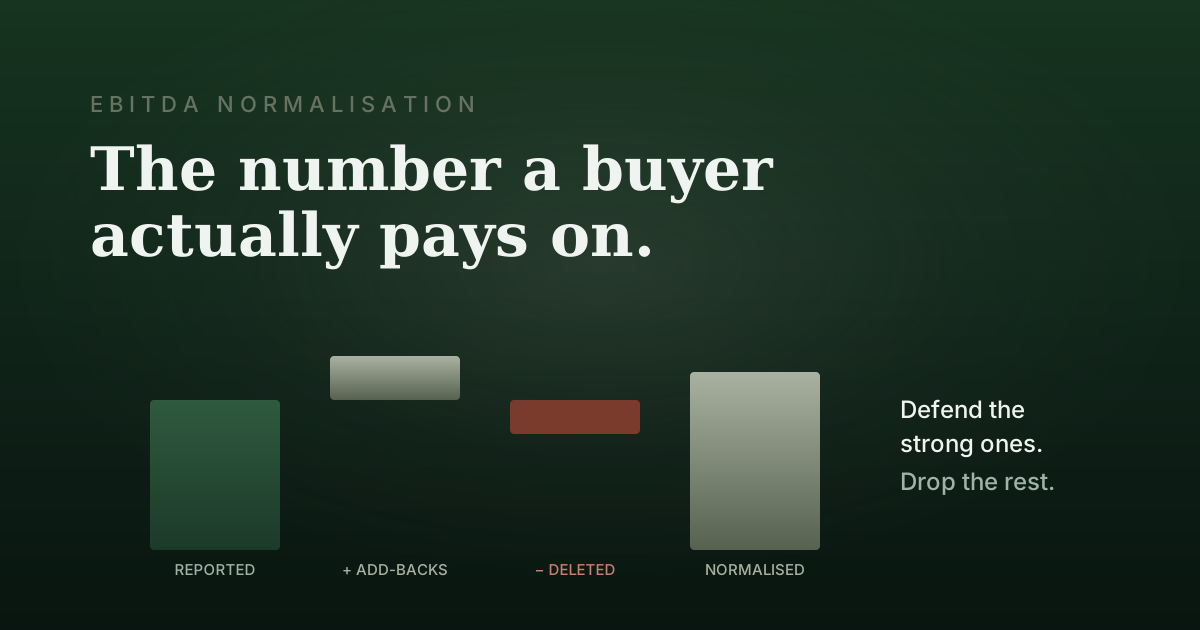
The number your accounts show as EBITDA is almost never the number a buyer values the business on. They work from normalised EBITDA, which is the reported figure adjusted for anything that distorts the true, ongoing earning power of the business. Get the normalisation right and you’re paid on earnings that reflect reality. Get it wrong, in either direction, and you either leave money on the table or hand a buyer a reason to distrust everything.
This matters more than owners expect, because the multiple applies to the normalised number. On a 5x multiple, every $100K you can legitimately add back and defend is worth $500K of enterprise value. Every $100K a buyer strikes off your list is $500K gone. Normalisation is where a surprising amount of the final price actually gets decided, and most owners walk into it having never thought about it properly.
What an add-back actually is
An add-back is an adjustment that removes the effect of a cost or a benefit a new owner wouldn’t carry, so the earnings reflect how the business would run under normal, arm’s-length ownership. The logic is simple: a buyer wants to see what the business really earns once your personal fingerprints are taken off the P&L. Some of those adjustments push EBITDA up. Some push it down, and the honest ones include both.
The reason it needs doing at all is that an owner-led business runs money through the P&L that a corporate owner wouldn’t. Your salary might be above or below market. The business might carry your car, your travel, a family member’s wage, or a one-off cost that’s never coming back. None of that reflects the ongoing earning power of the business, so it gets adjusted out to reveal the real number underneath.
The add-backs a buyer will usually accept
Some adjustments are standard, and a reasonable buyer expects to see them. The test each one has to pass is whether it’s genuinely non-recurring or genuinely non-operational, and whether you can prove it.
Owner remuneration above market. If you pay yourself $400K for a role a hired manager would do for $200K, the extra $200K is a legitimate add-back, because a new owner would replace you at market rate. This cuts the other way too: if you underpay yourself, honest normalisation lowers EBITDA to reflect the real cost of the role, and leaving that out is exactly the kind of thing that unravels in diligence.
Genuine one-off costs. A legal settlement that won’t recur, a flood repair, the cost of a project that’s been abandoned. Real, documented, and clearly not part of normal operations.
Personal expenses run through the business. Your vehicle, personal travel, a family member on payroll who doesn’t work in the business. Add them back, but be ready to show they were genuinely personal and not quietly load-bearing.
Non-market related-party costs. Rent paid to yourself on a building you own, above or below what the market would charge. Normalised to a market rate, in whichever direction that runs.
The ones a buyer will challenge or delete
This is where owners get into trouble, usually by being too generous. A buyer’s advisor deletes add-backs for a living, and the weak ones don’t just get struck off. They cost you credibility on the strong ones.
“Exceptional” costs that happen every year. A one-off that recurred in three of the last four years isn’t one-off. Marketing campaigns, “unusual” repairs, and consulting projects that turn out to be a regular feature of the business all get put straight back into the earnings.
Discretionary costs dressed up as non-recurring. Cutting a genuine operating cost right before a sale and adding it back as if a new owner won’t need it. If the business actually needs that spend to keep running, a buyer treats it as operational, and they’re right to.
Optimistic run-rate adjustments. Adding back the full annualised benefit of a change made two months ago, as if it’s already fully banked. Buyers discount unproven run-rate heavily, because they’ve watched too many of them fail to materialise.
Owner “goodwill” the business can’t survive without. Add-backs that assume relationships, judgement, or effort you personally provide can be removed at no cost. Where the earnings depend on you, a buyer treats that as founder dependency they’re already discounting for, not as an add-back that lifts the number.
Why an aggressive list costs more than it wins
Here’s the part that runs against instinct. The temptation is to maximise add-backs, push the normalised number as high as it will go, and negotiate down from there. It usually backfires, and the reason is about trust rather than arithmetic.
A buyer reads your add-back schedule as a signal of how you present the whole business. A tight, conservative, fully evidenced list says the rest of the numbers can probably be trusted. A long, generous list full of stretch adjustments says the opposite, and it changes how they read everything else. Once one add-back looks engineered, the buyer stops taking your numbers at face value and re-checks all of them, which is slower, more adversarial, and worse for your price. A smaller normalised figure a buyer believes completely is worth more than a bigger one they’ve decided to argue with line by line.
The stronger play is to be almost conservative. Include the add-backs you can defend without hesitation, leave off the marginal ones even when they’re arguably valid, and have the evidence ready before anyone asks. You give up a little on the headline number and get it back, with interest, in a buyer who trusts the schedule and prices accordingly.
Where this fits
Normalisation isn’t a thing you do in the week before a sale. The evidence that makes an add-back stick, meaning the contracts, the board minutes, the clean separation of personal and business costs, is far easier to assemble over two years than to reconstruct under time pressure with a buyer watching. Businesses that normalise well at sale are usually the ones that kept clean, buyer-ready books all along.
To start building yours, the free Add-Back Worksheet walks through each category and captures the evidence behind every adjustment, in the order a buyer’s advisor works through them.
Once you have a normalised figure, the Enterprise Value Gap Calculator shows what it’s actually worth once a buyer prices in the risks around it. If a sale is somewhere on your horizon, it’s worth getting a clear, honest view of what your normalised EBITDA actually is, and which of your add-backs would survive a buyer’s advisor, well before you’re in the room. That’s part of what a Commercial Assessment establishes, and the exit readiness work takes it through to a number you can defend when it counts.
Every business has one constraint doing most of the damage.
Find out what's constraining yours →2 questions · 60 seconds · No login