
The Business on One Page: Finding Your Value Hotspot
Trent West ·
Time to read: 9 minutes.
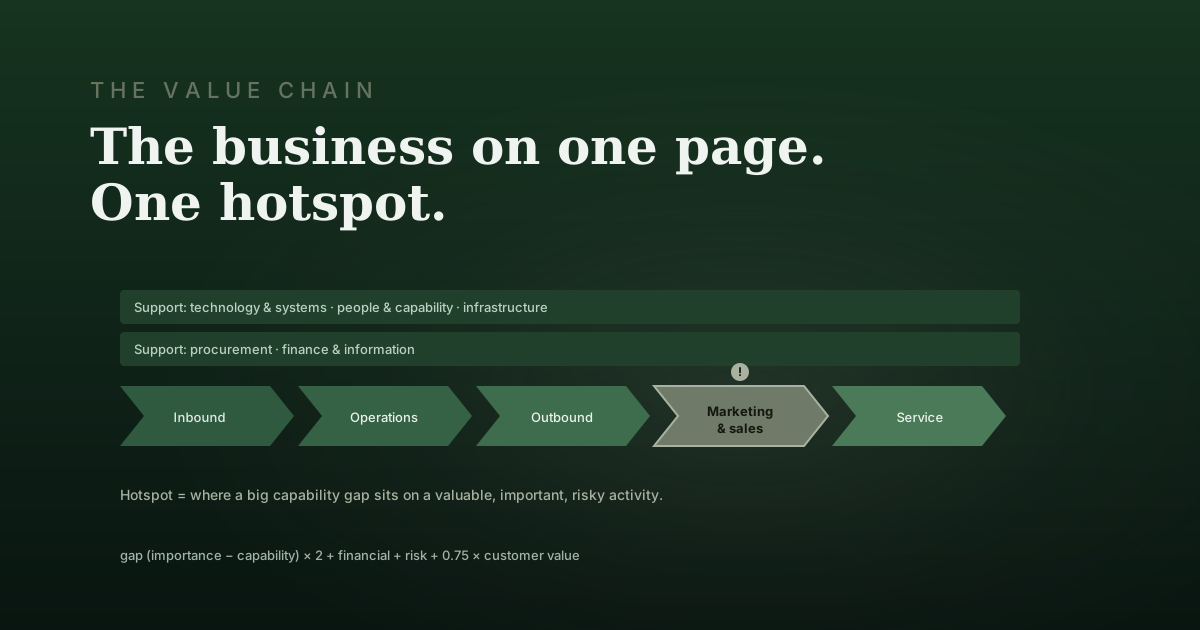
Ask an owner where their business needs to improve and you’ll usually get one of three answers: everywhere, or wherever the current fire is, or the part they happen to find most interesting. All three are ways of avoiding the actual question, which is narrower and much more useful. A business isn’t one thing that’s either working or not, it’s a chain of distinct activities, each of which you’re better or worse at, each of which matters more or less, and the practical question is which single one of them is worth improving first. Laid out properly, that question has a defensible answer, and it’s rarely the activity you’d have named off the top of your head.
See the chain, not the blob
The tool for this is old and underused: the value chain. Every business, whatever it sells, runs on a sequence of activities. Some are primary, the ones that directly create and deliver what the customer pays for: sourcing inputs, operations, getting the product out the door, winning customers, serving them afterward. Others are support activities that make the primary ones possible: your technology and systems, your people and capability, the basic infrastructure of the firm. Writing them all out on a single page is a modest act with an outsized effect, because most owners have never actually seen their business decomposed this way. The blob becomes a set of parts, and parts can be compared.
Rate each part on what actually matters
Once the activities are listed, you rate each one on a small set of dimensions, and the choice of dimensions is what makes this more than a list. How capable are you at it, honestly, relative to what good looks like. How strategically important is it, meaning how much does winning actually depend on it. How much do your customers care about it. How much money runs through it. How much risk is concentrated in it. And how differentiated you are at it, versus doing it the same way everyone else does. Six quick judgements per activity, and the picture that emerges is already more honest than most strategy documents, because it separates things owners routinely conflate: being good at something is not the same as it mattering, and something mattering is not the same as you being exposed on it.
The hotspot is a gap, not a weakness
Here’s the move that makes the exercise pay. The activity worth improving most is not simply the one you’re worst at, nor simply the most important one, but the one where a large capability gap sits on top of an activity that’s strategically important, financially material and carrying real risk. The centre of gravity is the gap between how important an activity is and how good you are at it, which is why that term deserves the most weight: it’s the fixable distance between what matters and what you can currently do. An activity you’re weak at that genuinely doesn’t matter is not a hotspot, it’s a candidate to stop worrying about. An activity that matters enormously but that you’re already excellent at is not a hotspot either, it’s a strength to protect. The hotspot is the expensive combination: this really matters, and we’re not good enough at it.
That distinction matters because it corrects a predictable bias. Owners over-invest in the activities they understand and enjoy, which for a founder is very often operations or the product itself, and they under-invest in the unglamorous, high-gap activity sitting quietly in the corner, which is very often sales, or the systems that would let the business scale. Scoring the chain drags that activity into the light. When the highest score lands on marketing and sales, or on the technology backbone, rather than on the operations the owner has spent years perfecting, the number is usually telling you something true and uncomfortable about where the next dollar of effort actually belongs.
Differentiation is a separate question
It’s worth reading differentiation on its own, because it answers a different question than the hotspot does. The hotspot tells you where to build capability. Differentiation tells you where you already stand apart, and just as importantly, where you’re doing a strategically important activity in exactly the same way as everyone else. An activity that’s important and undifferentiated is a quiet vulnerability, the place a competitor can match you without effort, and it often deserves attention even when its capability gap looks manageable. Being merely competent at the thing that’s supposed to set you apart is its own kind of hotspot.
The honest limits
Two caveats keep this useful rather than mechanical. The first is that the value chain is a snapshot and a simplification. Activities interact, and improving the one with the highest score can simply shift the binding constraint somewhere else, so the ranking is a place to start looking, not a complete causal map of the business. The second is that every number in it is a judgement, and a scoring model is only as good as the honesty of the person filling it in; rate everything you touch as strategically vital and the exercise tells you nothing. Used with discipline, though, it does something genuinely hard: it turns “the business needs to get better” into “this specific activity, for these specific reasons, is where improvement will pay most,” which is the difference between a wish and a plan.
You can map your own business with the Value Chain Hotspot tool: list your activities, rate each on the six dimensions, and see the ranked hotspots with the maths shown term by term. It reads naturally alongside the Competitor Scorecard, which tells you whether your strong activities are actually differentiated, and it’s the same one-page view a Commercial Assessment builds from evidence before the APG Platform turns the top hotspot into an owned, valued initiative.
Every business has one constraint doing most of the damage.
Find out what's constraining yours →2 questions · 60 seconds · No login