
Founder Dependency and What It Costs You at Sale
Trent West ·
Time to read: 8 minutes.
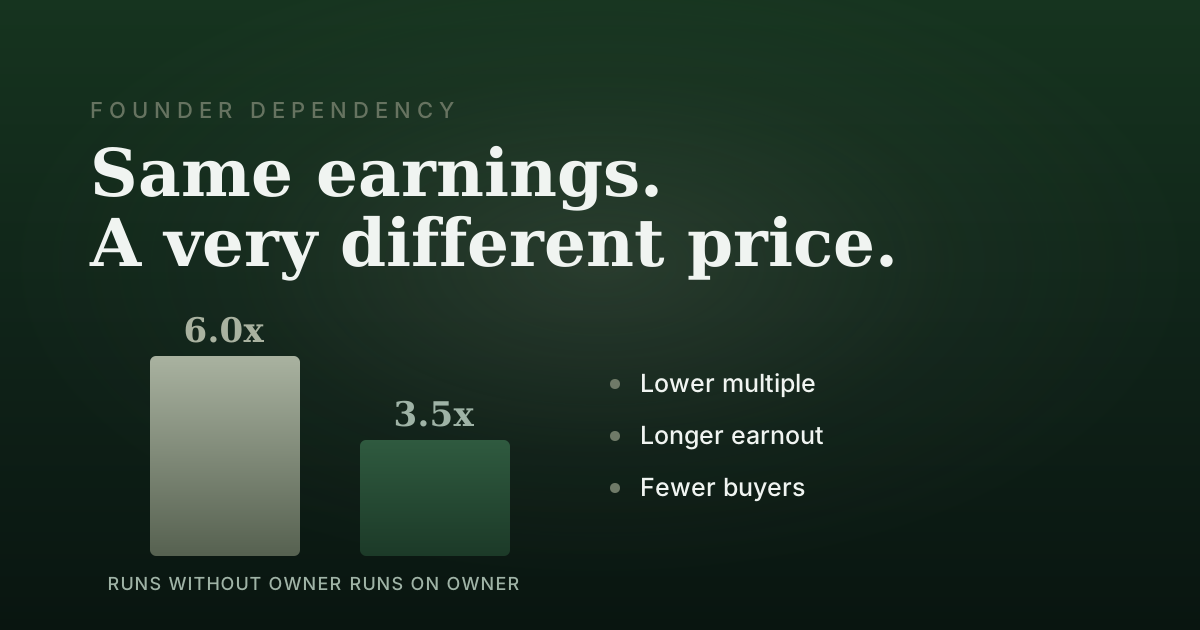
Two businesses earn the same $1.2M. One sells for 6x. The other struggles to get 3.5x, and the owner never quite understands why, because on paper the businesses look the same. The earnings are identical. What differs is how much of the business still runs through one person, and a buyer can see it from across the room.
Founder dependency is the most expensive problem owners don’t have on their books. It never shows up as a line item. There’s no account called “the business can’t run without me,” and no adjustment for it in the management reports. So it stays invisible right up until the moment it gets priced, which is usually in a data room, in front of a buyer, at the worst possible time to discover it.
Why a buyer discounts it, in plain terms
Enterprise value is the market’s confidence that future cash flows will arrive. A buyer isn’t paying for last year’s profit. They’re paying for their belief that the profit keeps coming after the person who built it has been paid out and left. Everything a buyer does in diligence is an attempt to test that belief.
Founder dependency attacks it directly. If the pricing calls, the key relationships, the technical judgement, and the day-to-day firefighting all sit with the owner, then the thing the buyer is purchasing walks out the door on completion day. They’re not buying a business that earns $1.2M. They’re buying the hope that a business can be rebuilt around whoever replaces you, and hope prices at a discount. The heavier the dependency, the wider the discount, and past a certain point it stops being a discount at all and becomes a reason the deal doesn’t happen.
How it actually gets priced
The discount isn’t a vague haircut. Buyers price it through specific mechanisms, and it helps to know which ones you’re up against.
The multiple comes down. This is the cleanest one. Same earnings, a lower number in front of them, because the risk of disruption after handover is higher. On a business doing $1.2M, the move from 6x to 4x is $2.4M of value, and none of it is recoverable once the buyer has seen how the business runs.
The earnout gets longer and larger. When a buyer isn’t confident the business survives without you, they solve it by keeping you in it. More of the price gets pushed into a multi-year earnout, tied to the business hitting targets while you’re still there. That’s less money at completion, more risk on you, and years longer before you’re actually out.
The handover terms harden. Longer transition periods, tighter non-competes, a chunk of the price held back in escrow against the transition going badly. Each of those is the buyer pricing the same worry a different way.
And the buyer pool shrinks. A trade buyer with their own management bench can absorb some founder dependency. A financial buyer, or an owner-operator buying a job, often can’t, and they screen it out early. Fewer bidders means less competitive tension, which quietly costs you more than any single line item, because price at sale is mostly a function of how many credible buyers are at the table.
The honest part most advice skips
Founder dependency in the early years is correct, not a mistake. A business at $2M revenue should run on the founder’s judgement, because building the systems to replace that judgement before there’s anything to systematise is just overhead with no return. The instinct to be across everything is the same instinct that got the business built in the first place.
The problem is that the operating model that was right at $2M doesn’t get retired when the business hits $8M. The decisions that needed the founder early still route through the founder late, long after the business could afford to build something better. So there’s no character flaw here to feel bad about. What happened is that the business outgrew a stage without anyone noticing, because the person it depends on was too busy running it to stop and change how it runs.
How to know how bad yours is
You can’t fix what you haven’t measured, and most owners genuinely can’t see their own dependency, because they’ve absorbed it for so long it feels like just how the business works. A few honest tests cut through it, and the Owner Dependency Score turns them into a number and a rough value at risk.
Take a real two-week holiday, properly unreachable, and see what’s on fire when you get back. What broke, and what decisions simply waited for you, is your dependency map, drawn from life rather than from a whiteboard.
Look at where the important relationships actually sit. If your biggest customers and key suppliers deal with you personally rather than with the business, those relationships are yours, and a buyer knows they might leave with you.
Ask who else can price a job, approve an exception, or make the call when something falls outside the usual. If the honest answer is “only me” more often than it’s comfortable to admit, the business is narrower than its revenue suggests.
Watch how decisions flow for a week. Count how many come back to you that genuinely needed you, versus how many come back out of habit because that’s how it’s always worked. The gap between those two numbers is the part you can hand off without the business noticing.
What actually moves it, and why it takes time
Reducing founder dependency is slow work, and that’s exactly why it has to start well before a sale is on the table. You can’t build a management layer, transfer a decade of relationships, and prove the business runs without you in the ninety days before you go to market. A buyer knows that too, which is why dependency that’s been genuinely resolved reads as credible and dependency that’s been hastily papered over reads as exactly what it is.
The work is unglamorous and it compounds. Moving relationships onto the company’s books, one introduction at a time. Writing down how the judgement calls actually get made, so the reasoning transfers and not just the outcome. Building people who can make real decisions while you’re still there to catch the misses, which means letting them make some wrong ones. Stepping back deliberately and in stages, so the business learns to run without you while there’s still time to fix what doesn’t. Every one of those converts a piece of the business that depended on you into a piece that doesn’t, and each piece you convert is value that stays in the business when you leave it.
There’s a version of this that’s worth being honest about: it can feel like making yourself redundant, and some owners resist it for exactly that reason. But redundancy is the goal. A business that no longer needs you is the only kind you can sell at full value, or hand to the next generation, or simply step back from without it falling over.
If you’re three years or less from wanting out, the first move is a clear-eyed read on where the dependencies actually sit and what they’re costing you in enterprise value today. That’s what a Commercial Assessment is built to surface, and the founder dependency work maps the specific dependencies, quantifies them, and builds the structure to change it before a buyer ever sees the business.
Every business has one constraint doing most of the damage.
Find out what's constraining yours →2 questions · 60 seconds · No login