
Growth Without Operating Discipline
Trent West ·
Time to read: 13 minutes.
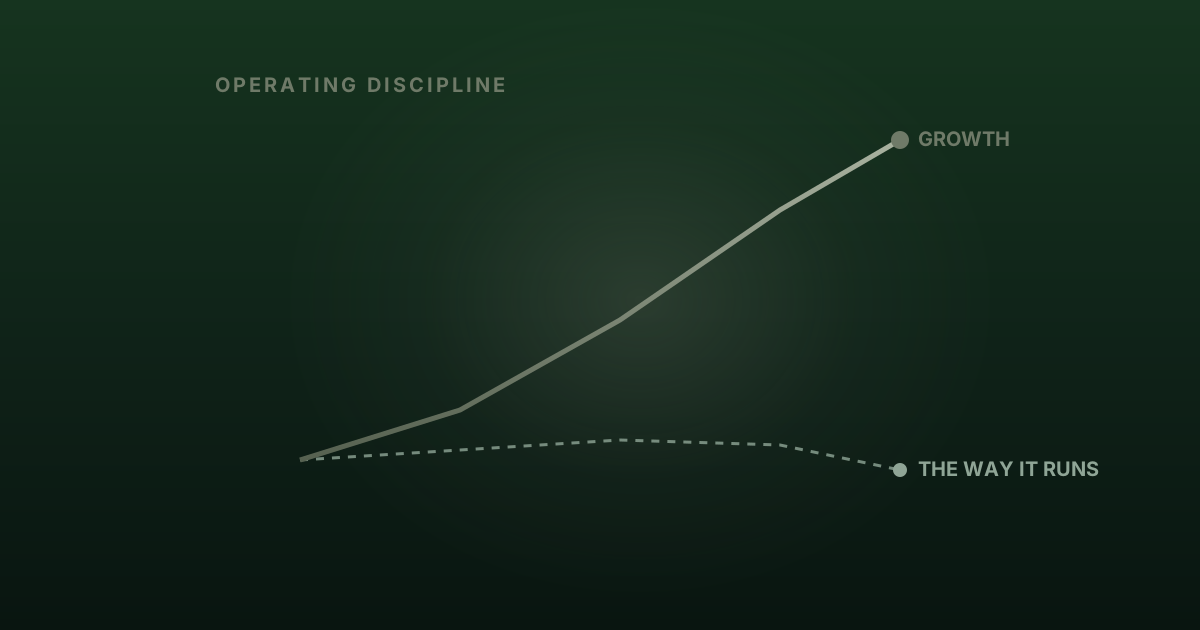
Growth is a good problem to have.
More customers, more revenue, more employees and more opportunity are all signs that a business has created something the market values. For an owner-led business, that growth is often the result of years of persistence, commercial instinct and personal effort.
The difficulty is that growth changes the business faster than many owners expect.
The same operating habits that work well at $3 million in revenue may become unreliable at $10 million. The same leadership model that works with 15 employees may start to break down at 50. Decisions that were once made quickly between a few experienced people begin to involve more functions, more information and more consequences.
Nothing has necessarily gone wrong. The business has simply reached a point where informal coordination is no longer enough.
This is where growth without the way the business is run begins.
The business continues to expand, but the underlying management system does not develop at the same pace. Revenue rises, yet margin becomes less predictable. More people are hired, but the owner remains heavily involved in day-to-day decisions. Reporting increases, but commercial visibility does not. The organisation is working harder, although it is not always clear whether it is becoming stronger.
For many owner-led businesses, this is one of the most important transitions to manage.
Growth creates a different management problem
In the early stages of a business, the owner is often the operating system.
They understand the customers, know where the risks sit, make the key decisions and resolve issues as they arise. They can move quickly because they hold much of the commercial context personally.
This is not a weakness. It is often a major reason the business succeeds.
The problem emerges when the business grows beyond the point where one person, or a small leadership group, can continue to carry that context across the entire organisation.
As more people, products and customers are added, the business begins to require a more explicit way of operating. Priorities need to be clearer. Decision rights need to be more defined. Performance needs to be visible without relying on the owner to interpret everything personally.
At this stage, the question is no longer simply: How do we keep growing?
It becomes: How do we grow without making the business harder to control, less profitable or more dependent on the owner?
That is a different management problem.
The first signs are often easy to explain away
Growth without discipline rarely appears as a dramatic failure. It usually develops through a series of small compromises.
A customer issue is resolved by the owner stepping in. A margin problem is blamed on temporary hiring costs. A weak manager is supported for longer than intended because the business is too busy to replace them. A new system is introduced to improve visibility, but the underlying reporting logic remains unclear. A meeting is added because communication is inconsistent. Another approval layer is added because a decision went wrong.
Each response may be reasonable in isolation. Over time, however, the business accumulates workarounds rather than building a stronger operating model.
The warning signs are usually familiar.
Revenue is increasing, but profit is not improving at the same rate. The leadership team is busy, but important decisions still return to the owner. Different teams report different versions of performance. Customer experience varies depending on who handles the work. Managers are accountable for results but do not have clear authority. There are too many priorities and too few completed initiatives. The business has more data than before, but leadership still lacks confidence in what the numbers mean.
None of these issues automatically indicates a serious problem. Together, they often signal that the business has outgrown parts of the way it is being managed.
Growth and scale are not the same thing
A business grows when it becomes larger.
A business scales when it can become larger without a corresponding increase in complexity, cost and management effort.
The distinction matters.
If revenue increases by 30 per cent but management workload, headcount, rework and customer complaints also increase by 30 per cent, the business has grown. It may not have become more efficient or valuable.
True scale is visible in the quality of growth. Margins remain stable or improve. Customer experience becomes more consistent. The business can absorb higher volumes without constant intervention. Managers make sound decisions within clear boundaries. The owner spends more time on direction, capital allocation and major relationships, and less time resolving operational ambiguity.
This is why revenue growth alone is not enough to judge whether the business is progressing.
A better set of questions is:
- Is each new dollar of revenue producing an acceptable return?
- Is the business becoming easier or harder to manage?
- Are decisions moving closer to the people responsible for the outcome?
- Is performance becoming more visible?
- Is the owner becoming less operationally essential?
- Is the organisation building repeatable capability?
These questions reveal whether growth is strengthening the business or simply increasing its size.
Where the way the business is run usually breaks down
Most owner-led businesses do not need a wholesale transformation. They need to address a small number of recurring gaps.
1. Commercial visibility
Many growing businesses manage performance at a high level.
They know total revenue, total payroll and total profit. What they cannot always see clearly is which products, customers, channels or locations are creating value and which are consuming it.
This matters because growth often changes the revenue mix.
The business may be winning more work, but at a lower margin. A new channel may generate volume while increasing acquisition costs. A high-profile customer may absorb disproportionate resources. A product may look successful because of revenue while contributing very little after delivery costs are considered.
Without this visibility, management is forced to make decisions using averages.
The first practical step is to establish a commercial baseline. At a minimum, the business should be able to see:
- revenue by product, customer segment and channel;
- gross margin by product or service line;
- direct labour or delivery cost;
- customer acquisition cost;
- conversion rate;
- average transaction or contract value;
- delivery capacity and utilisation;
- customer retention or repeat purchase;
- contribution after direct operating costs.
This does not require a sophisticated business intelligence platform. It requires agreement on the few measures that actually explain commercial performance.
The objective is to move from: We are growing. to: We know where growth is creating value and where it is not.
2. Priority discipline
Owner-led businesses are often highly responsive. That is a strength, but it can also create too many concurrent priorities.
New ideas are added quickly. Customer requests become projects. Problems trigger initiatives. Opportunities are pursued because they appear attractive or urgent.
The result is often a business with significant activity but limited completion.
A useful discipline is to separate:
- what must be protected;
- what must be improved;
- what should be explored;
- what should stop.
This forces the leadership team to acknowledge that resources are finite.
A practical 90-day priority process can be simple. Select three to five enterprise priorities. For each priority, define:
- the commercial outcome required;
- the accountable executive;
- the key actions;
- the measure of success;
- the major dependencies;
- the decision points;
- the completion date.
Everything else should either support those priorities, remain part of normal operations or be deferred.
The purpose is not to suppress initiative. It is to prevent the business from spreading management attention across more work than it can execute well.
3. Decision rights
As businesses grow, decisions become slower when it is unclear who has authority.
Managers may be responsible for outcomes, but major decisions continue to be escalated. Owners become involved because the stakes are higher, the boundaries are unclear or previous decisions have produced inconsistent results.
This is often misdiagnosed as a capability problem. Sometimes it is. Often, it is a design problem.
Managers cannot exercise good judgement if they do not understand:
- which decisions they own;
- which decisions require consultation;
- which decisions require approval;
- what financial or operational thresholds apply;
- when escalation is expected.
A decision-rights framework does not need to cover every possible situation. It should focus on the decisions that repeatedly create delay or confusion. For example:
- pricing and discounting;
- hiring;
- supplier commitments;
- customer remediation;
- capital expenditure;
- project prioritisation;
- policy exceptions;
- credit terms;
- product changes.
Clear decision rights reduce unnecessary escalation without removing appropriate control.
4. Accountability
Many businesses have job descriptions but limited outcome accountability.
A manager may be responsible for sales, operations or customer service, yet the actual result is shared across several people. When performance falls short, everyone has contributed, but no one is clearly accountable for the whole outcome.
Operating discipline requires named ownership.
Each critical business outcome should have one accountable owner. That person may rely on several teams, but they remain responsible for coordinating the work, understanding performance and bringing forward decisions.
Good accountability is specific.
It does not say: Improve customer experience. It says: Reduce customer complaints from 8 per cent to 4 per cent within six months while maintaining service response times.
It does not say: Grow sales. It says: Increase qualified pipeline by $2 million and maintain conversion above 25 per cent.
It does not say: Improve productivity. It says: Increase billable utilisation from 62 per cent to 72 per cent without reducing quality.
Clear accountability changes management conversations. It moves discussion away from effort and toward outcomes.
5. Management cadence
As businesses grow, meetings tend to multiply.
The problem is rarely a lack of meetings. It is that the meetings are not structured around the decisions the business needs to make.
A useful management cadence should separate different types of discussion. Weekly operational meetings should focus on immediate performance, exceptions and decisions. Monthly performance reviews should examine trends, causes and accountability. Quarterly reviews should assess strategic priorities, resource allocation and whether the business is still pursuing the right opportunities.
These meetings should not become general updates.
A practical weekly agenda might include:
- What changed in the key numbers?
- Where are we off plan?
- What is causing the variance?
- What decision is required?
- Who owns the action?
- When will the result be reviewed?
This creates a direct line between information, decision and action.
The owner’s role must evolve with the business
One of the hardest parts of this transition is that the way the business is run also requires a change in the owner’s role.
In the early stages, the owner creates value by being involved in everything important.
As the business grows, that same involvement can begin to limit scale.
The owner’s role needs to move gradually from solving problems to designing the conditions in which other people can solve them well. That includes:
- setting direction;
- choosing where the business will and will not compete;
- allocating capital;
- appointing capable leaders;
- clarifying decision rights;
- holding people accountable;
- protecting culture and standards;
- maintaining visibility over commercial performance.
This does not mean becoming detached from the business. It means becoming involved at the level where ownership adds the most value.
A useful question for any owner is: Which decisions still genuinely require me, and which decisions return to me because the business has not yet built enough clarity or capability?
That distinction is critical.
A practical 90-day response
Businesses do not need to fix everything at once.
A focused 90-day period can create meaningful improvement if it is directed at the right issues.
First 30 days: establish the baseline
The first month should be used to understand the current operating reality. This includes:
- validating the core financial and commercial numbers;
- identifying where margin is created and lost;
- mapping the main value chain;
- clarifying major decision bottlenecks;
- identifying repeated sources of rework or delay;
- reviewing the current meeting and reporting cadence;
- determining where the owner remains unnecessarily central.
The aim is not to produce a long diagnostic report. It is to identify the small number of constraints with the greatest commercial impact.
Days 31 to 60: redesign the critical controls
The next phase should establish the management structure required to address those constraints. This may include:
- defining three to five enterprise priorities;
- assigning clear outcome accountability;
- redesigning the executive scorecard;
- clarifying decision rights;
- setting pricing or margin controls;
- simplifying reporting;
- removing low-value meetings;
- establishing a more disciplined review cadence.
The objective is to create clarity before adding further process.
Days 61 to 90: embed the new cadence
The final phase should focus on consistent use. Leadership meetings should operate from the new scorecard. Accountable executives should report against outcomes rather than activity. Decision rights should be tested in practice. Priority progress should be reviewed openly. Initiatives that are not delivering value should be stopped or reset.
At the end of 90 days, the business should be able to answer three questions more clearly:
- What matters most?
- Who owns it?
- How will we know whether it is improving?
The aim is not more structure. It is better control.
Owner-led businesses often resist formalisation because they do not want to become bureaucratic.
That concern is valid.
The answer is not to introduce layers of process, larger reporting packs or more approval points. Those things can make the business slower without making it better managed.
The aim is to create the minimum effective structure required for the business to operate with clarity.
Good the way the business is run should make the business:
- easier to understand;
- faster to manage;
- clearer to lead;
- more consistent for customers;
- less dependent on individual knowledge;
- more capable of converting growth into profit and enterprise value.
It should reduce complexity, not add to it.
The real test of growth
The real test of growth is not whether the business is larger than it was last year.
It is whether the business is becoming more capable.
Can it serve more customers without creating disproportionate pressure? Can managers make sound decisions without relying on constant owner intervention? Can leadership identify where profit is being made and lost? Can the organisation focus on a small number of priorities and complete them? Can performance be understood quickly enough to act? Can the owner step back from parts of the operation without standards falling?
These are the signs that growth is being converted into scale.
Growth without the way the business is run is not a failure of ambition or leadership. It is a normal stage in the development of many successful owner-led businesses.
The risk lies in allowing the business to remain there for too long.
The businesses that make the transition successfully do not abandon the entrepreneurial strengths that created their success. They support those strengths with clearer commercial visibility, stronger accountability and a management system suited to the size and complexity of the business they have become.
Every business has one constraint doing most of the damage.
Find out what's constraining yours →2 questions · 60 seconds · No login