
How to Increase EBITDA Before Selling Your Business
Trent West ·
Time to read: 8 minutes.
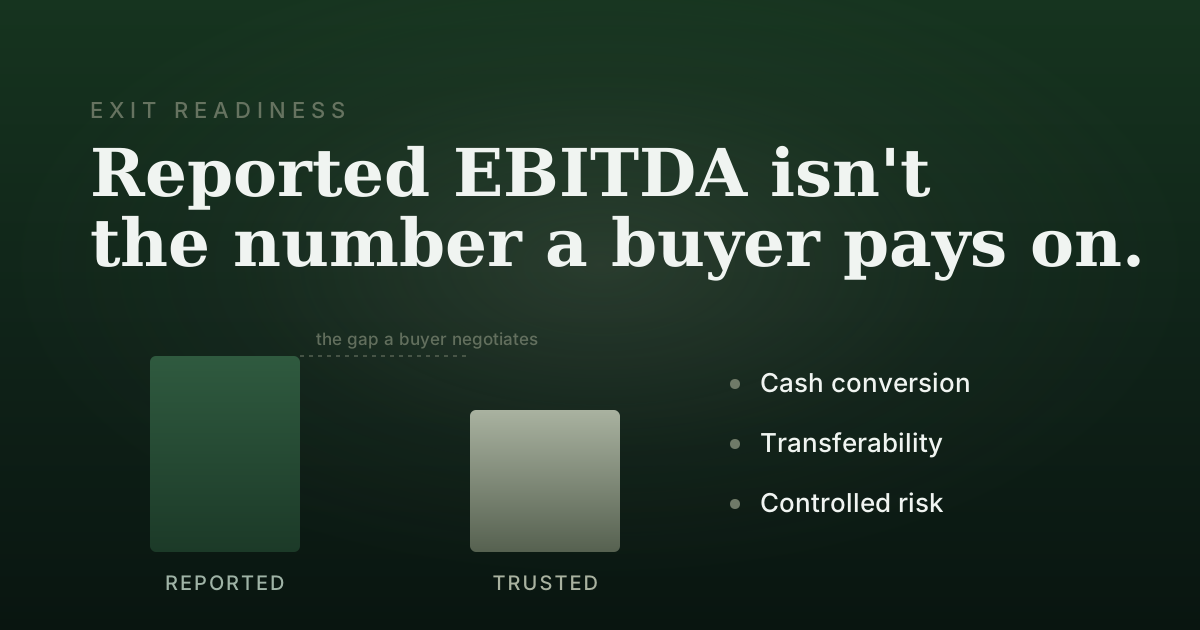
Add $200K of EBITDA in the twelve months before you go to market, and there’s a decent chance you’ve made the business harder to sell, not easier. Buyers know what a pre-sale sprint looks like. A number that jumps right before due diligence gets picked apart, not applauded.
That’s the part most advice on this topic skips. There are really two separate jobs here, and owners tend to do the first and skip the second. Job one: grow the earnings. Job two: get a buyer to believe them, and believe they’ll still be there the year after you’ve gone. A dollar of EBITDA a buyer trusts is worth a multiple. A dollar they don’t trust gets negotiated down, or used to argue the whole number is soft.
Worth saying plainly, because it changes where you should spend your time. The multiple moves independently of the earnings, and it’s usually worth more. A business on $1.4M EBITDA at 4.5x is worth $6.3M. Get that same business in front of a buyer comfortable enough to pay 5.5x, with no change to the earnings at all, and it’s worth $7.7M. That’s $1.4M of value for zero dollars of extra profit. Most of what follows is really about that second lever, and three things move it more than anything else: whether the EBITDA turns into cash, whether the business runs without you, and whether the compliance base holds up under scrutiny.
First, clean up the number so it survives inspection
Recast the earnings properly, and document every adjustment like you expect to be challenged, because you will be. Above-market owner salary. The relative on payroll who isn’t really in the business. A one-off legal bill. A lease renegotiated after the fact. All real add-backs, but only with a paper trail a buyer’s accountant will accept without a fight. Skip the paper trail and the buyer’s advisor just deletes the line in front of you.
Then go looking for cost that doesn’t do anything, rather than cost in general. Blanket cuts before a sale read as exactly what they are: a business trimmed to look better for twelve months, and a sharp buyer will ask what breaks in month thirteen. Duplicate software, a management layer added during a growth phase that never got removed, a supplier contract nobody’s touched since it was signed, an insurance policy nobody’s re-shopped in years. That’s the kind of cost that comes out clean and stays out.
Margin usually does more than growth, and it’s faster to fix. New revenue is the instinctive lever, and buyers do want to see the top line moving. But a dollar of margin improvement is a dollar of EBITDA, full stop, while a dollar of new revenue has cost of delivery attached before it counts for anything. Pricing that hasn’t moved with input costs in two years, or a service line quietly running near break-even. Those are usually the faster wins, and more credible to a buyer than a growth story with twelve months left to prove itself. The Pricing Power Calculator shows how much a modest, defensible rise is worth once it flows to EBITDA and the multiple.
EBITDA only counts if it turns into cash
Here’s where a lot of otherwise strong numbers come apart in diligence. EBITDA is an accounting figure. Cash is what the buyer actually gets, and a buyer runs the bridge between the two before they take your multiple seriously. If the business reports $1.4M of EBITDA but only $700K of it ever lands in the bank, you don’t have a $1.4M business in the buyer’s eyes. You have a $700K business with a working-capital problem attached.
The gap between the two usually lives in a few places. Receivables that have quietly stretched from 45 days to 70, so growth is being funded by money you haven’t collected. Inventory that’s grown faster than sales, which is cash sitting on a shelf. Revenue recognised up front on work that gets delivered, and paid for, over the following year. Capex that’s been deferred rather than avoided, which means the buyer inherits a bill you’ve been putting off. None of it changes reported EBITDA. All of it changes what the earnings are worth.
The work here isn’t cosmetic. Tightening collections, resetting payment terms, clearing dead stock, and getting maintenance capex onto a real schedule does two things at once. It frees up cash you can actually use before any sale, and it closes the gap a buyer would otherwise use to knock the number down. EBITDA that converts cleanly to cash is EBITDA that holds its multiple. The rest gets argued about. If you want to see the size of your own gap, run your figures through the EBITDA-to-Cash Converter.
Processes that leave with you are earnings a buyer discounts
This is the one owners underrate most, because it doesn’t show up as a line item until someone goes looking. A business that can’t run without the founder gets a real, material discount applied to it. The earnings aren’t in question. Confidence they survive the handover is.
Think about what actually walks out the door when you do. The pricing judgement that lives in your head. The supplier who gives you terms because they’ve known you for fifteen years. The three big customers who buy from you, not from the company. The tacit knowledge of how the work really gets done, none of it written anywhere. A buyer sees all of that, and every piece of it that depends on you personally is a piece of the earnings they can’t be sure they’re buying.
Documented and transferable is the standard, and it’s a higher bar than documented alone. A procedure that’s written down but that only you know how to actually run hasn’t transferred anything. The test is whether someone competent could pick it up and get the same result without calling you. Getting there means writing down how decisions get made and not just what the decision was, moving key relationships onto the company’s books rather than your personal ones, and building a layer of management that makes real calls while you’re still there to catch the mistakes. Every one of those moves converts a piece of founder-dependent earnings into transferable earnings, and transferable earnings are the only kind that hold full value at exit. It’s the practical work behind the founder dependency discount, and it’s slow, which is why it has to start early.
Compliance risk doesn’t discount the multiple. It caps it.
The levers above move value in fractions of a turn. Regulatory and compliance exposure behaves differently, and worse. A live, unmanaged compliance problem doesn’t shave the multiple. It can put a ceiling on the whole deal, or end it.
The reason is how a buyer prices something they can’t size. A worker classification question, a licensing gap, unpaid payroll tax, a data or privacy exposure, an environmental liability, in a regulated sector the audit and registration risk that comes with it. Left unquantified, a buyer can’t assume the best case, because they can’t defend that assumption to anyone. They assume something near the worst, because that’s the only number they can stand behind with nothing in front of them. An exposure that might genuinely cost $300K gets priced at $2M, or handled with an indemnity and an escrow that locks up a chunk of your proceeds for two years, or it sends the buyer quietly off to look at something safer instead.
Managed and controlled is what changes the price, and managed doesn’t mean solved. Often you can’t fully solve a binary risk before a sale. What you can do is measure it, get an opinion on it, provision for it, and show a buyer a documented plan. The same exposure, quantified at $300K with advice and a provision behind it, prices at roughly $300K. The difference between those two outcomes is the difference between a controlled risk and an open one, and on a real deal it’s frequently worth more than a year of the earnings improvement you worked so hard on. This is risk exposure work, and it’s worth an honest look well before anyone opens a data room.
The concession worth making honestly
Everything above cuts against a faster instinct, and the instinct is sometimes right. Normalisation can go too far, and when it does, it costs more than it saves. An add-back list that reads as generous rather than defensible doesn’t just get challenged line by line. It changes how the buyer reads everything else in the data room. Once one number looks engineered, every number gets re-checked. Most of the time, fewer add-backs with better evidence beats a longer list with thinner support. The same logic runs through all of this: a smaller number a buyer fully believes is worth more than a bigger one they have to take on trust.
Why timing does most of the work
None of this reads well on a ninety-day clock. A buyer doing due diligence is specifically looking for changes that cluster right before a sale process, because that’s the signature of a number built for them rather than a number the business actually runs on. Cash conversion, transferability, and a controlled compliance base all take longer than a quarter to establish, and they all read as more credible precisely because they took time. The changes that hold up, and the multiple that holds up with them, are the ones made twelve to twenty-four months out, with enough runway for the improvement to show up as a trend a buyer can underwrite rather than a spike they have to take on faith.
If you’re weighing an exit in the next one to three years, skip the forecast for now. Get an honest, current read on where cash and profit are actually being made and lost, how much of the business still depends on you, and what a buyer would flag in week one if they looked today. That’s what a Commercial Assessment is built to produce: a fixed-scope, fixed-fee view of what’s actually worth fixing before anyone else sees the numbers. If exit is specifically the goal, exit readiness picks up from there.
Every business has one constraint doing most of the damage.
Find out what's constraining yours →2 questions · 60 seconds · No login