
The Commercial Due Diligence Checklist for Owner-Led Businesses
Trent West ·
Time to read: 5 minutes.
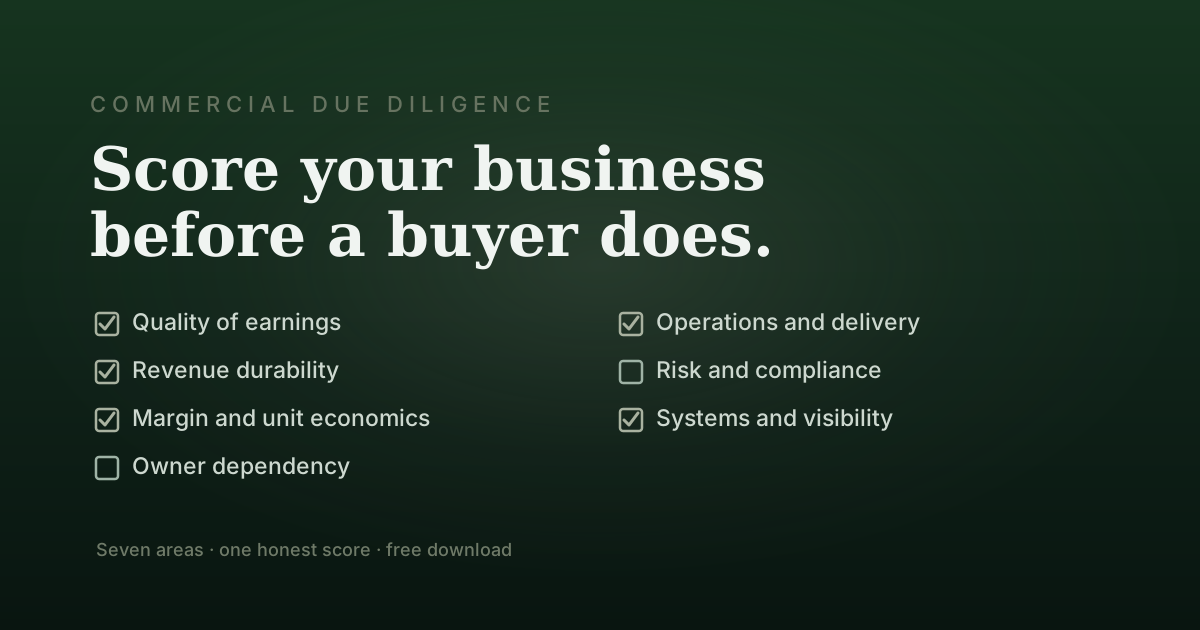
Every serious buyer runs commercial due diligence before they hand over money. They pull apart the earnings, the customers, the margins, the risks, and the question of whether the business runs without you. By the time they do it, the answers are fixed. Whatever they find is what they price on, and you’re negotiating from the back foot.
The obvious move is to run the same examination on yourself first, early enough that the answers are still yours to change. That’s the whole idea behind the checklist below. It walks the same ground a buyer covers, so the things that would cost you in a data room show up now, while there’s time and runway to fix them.
Why a checklist beats a valuation here
A valuation gives you a number. It doesn’t tell you which specific things are holding that number down, or which are cheap to fix and which take years. A structured checklist does something a valuation can’t: it turns a vague worry about being “not quite ready” into a concrete list of gaps, each one a piece of value you can actually work on.
The framing that makes it useful is simple. Enterprise value is the market’s confidence that future cash flows will arrive. Every gap on the list is a place a buyer loses a little of that confidence, and prices accordingly. Close the gap and you’re not just tidying up. You’re removing a reason for someone to pay you less.
What it covers
The checklist runs across the seven areas where owner-led businesses most often lose value at sale:
Quality of earnings, meaning whether the profit you report is profit a buyer can actually rely on. Revenue durability, meaning how much of it survives the sale rather than walking out with you. Margin and unit economics, because the aggregate P&L hides where money is really made and lost. Owner and key-person dependency, because a business that can’t run without you is one a buyer isn’t sure they’re buying. Operations and delivery, where every process either serves an outcome, meets a real obligation, or is quietly costing you. Risk and compliance exposure, where an unquantified liability prices at its worst case rather than its actual size. And systems and visibility, because reporting that only records that activity happened won’t answer the questions a buyer asks.
Each item gets held to the same test we apply to every part of a business: can you see it, do you understand it, have you decided what to do about it, and does that then actually happen. A tick means all four. Anything less is a gap worth naming.
How to use it
Prefer to start on screen? The Exit Readiness Scorecard runs the same seven areas interactively and gives you a readiness band in a couple of minutes. Either way, work through it honestly, on your own numbers, and count the boxes you can’t tick. Most owner-led businesses land somewhere in the middle, with a handful to a dozen genuine gaps. That’s normal, and it’s useful, because nearly all of them are fixable with twelve to twenty-four months of runway. The value in the exercise is finding them while that runway still exists, rather than discovering them in front of a buyer when it doesn’t.
Download the Commercial Due Diligence Checklist (PDF) →
The gaps that cost the most are usually the ones you can’t see from inside the business. The checklist finds what you already half-know. A Commercial Assessment finds the rest: a fixed-scope, fixed-fee read of where value is actually being made and lost, and what to fix first, from outside the day-to-day where the pattern is easier to see. If a sale is specifically on the horizon, the exit readiness work takes it from there.
Every business has one constraint doing most of the damage.
Find out what's constraining yours →2 questions · 60 seconds · No login