
What to Do Next: How to Rank a Backlog Without Fooling Yourself
Trent West ·
Time to read: 8 minutes.
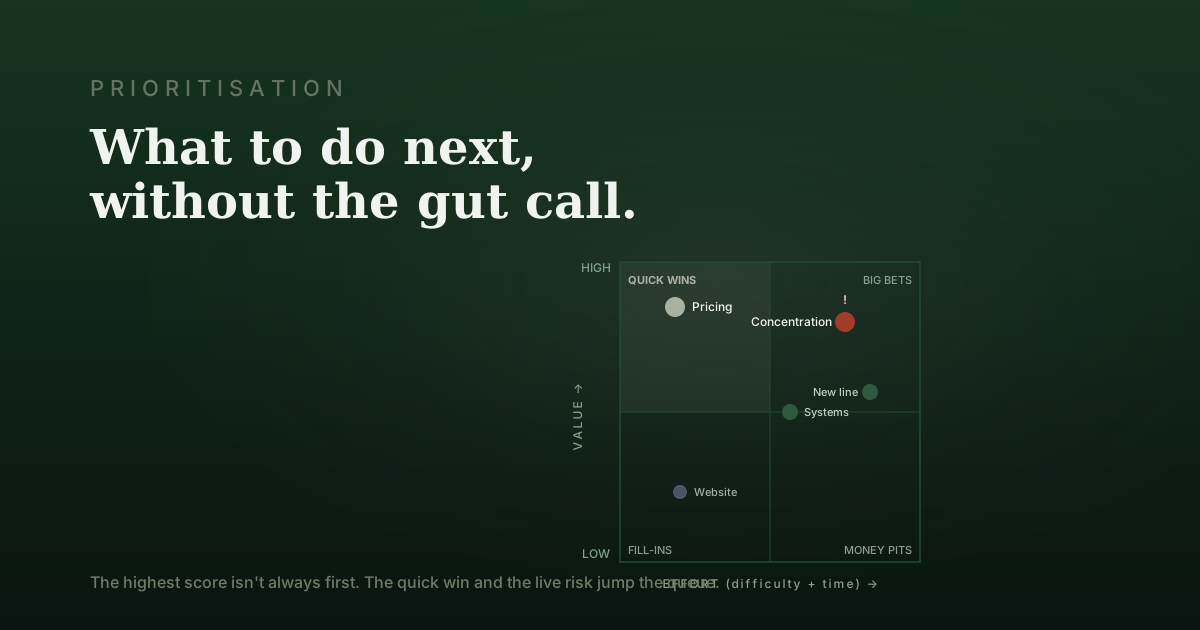
Every owner-led business has a backlog: a list of genuinely good ideas, any of which would help, none of which there’s time to do at once. The problem is almost never a shortage of things to do. It’s that they get done in an order that has nothing to do with what they’re worth. The idea whose champion is loudest gets resourced. The one that’s most enjoyable gets attention. The one that came up in last week’s meeting feels urgent because it’s recent. Ranking a backlog by gut consistently over-invests in the exciting and under-invests in the boring but valuable, and the cost of that is invisible, because you never see the return on the initiative you didn’t pick.
Nine factors, and a weighting you can’t fiddle
A scoring model fixes this by forcing every idea through the same questions. Seven factors push an idea up the list. The capability gap it closes, weighted most heavily because a big gap between where you are and where you need to be is the strongest signal of value. Its commercial impact on revenue, margin or cash. The risk it reduces. Its strategic importance to the business model. Its urgency. Its impact on customers. And how critical it is to succeeding in your particular industry. Two more factors push an idea down: how difficult it is to implement, and how long it takes to produce a measurable result. Weight the seven, subtract the two, and you get a score.
The most important property of that model is dull-sounding and essential: the weights are fixed, and the same for every idea and every business. Nobody gets to quietly turn up the weight on the factor that happens to favour their pet project. A scoring model’s entire job is to resist the person filling it in, not to confirm what they already wanted, and a model whose weights you can tune to reach your preferred answer is just your bias wearing a spreadsheet.
The score is not the plan
Here’s the part that separates a useful prioritisation from a naive one: the highest score is not automatically the thing to do first. Two categories of idea should jump the queue regardless of where their raw score lands, and both are invisible to a simple ranking.
The first is the critical item. An idea can carry a high score and still be a slow-burn improvement, while a slightly lower-scoring idea sits on top of an urgent, high-risk exposure that could hurt the business this year. Anything that combines a strong score with a genuine trigger, a risk that’s live now or a deadline that’s real, is critical, and it belongs at the top whatever the arithmetic says. The second is the quick win: an idea with meaningful value, low implementation difficulty and a fast payoff. Its total score might be modest, but a change you can make next month for little effort and real return should very often be done before a bigger, slower prize, because it banks value now and builds momentum. Reading these two bands, which are deliberately orthogonal to the raw score, is what turns a ranked list into an actual sequence.
Why the penalties matter as much as the value
Owners are naturally drawn to the impressive idea, and impressive ideas are usually big, hard and slow. That’s exactly why the two penalty factors, difficulty and time to impact, deserve real weight. An idea that scores enormously on value but is a two-year programme with serious execution risk is not the same investment as a smaller idea you can deliver next quarter, and a plan that ignores the cost of delivery quietly fills up with magnificent projects that never finish. Netting difficulty and time against the value is what keeps the list honest about capacity, which is always the binding constraint, and it’s what stops the quick, cheap, valuable move from being permanently crowded out by the grand one.
Evidence decides the bottom of the list
The bottom of a ranked backlog needs its own discipline, because a low score can mean two very different things. It can be an idea you’ve properly assessed and found genuinely marginal, which you should monitor and leave alone. Or it can be a big, exciting idea whose score is low only because it rests entirely on a hunch, with no evidence behind any of the numbers. Those deserve different treatment: the first you park, the second you either evidence or drop, because a large claim built on a guess should never outrank a modest one built on data. Damping a score by how confident you are in its inputs is what stops the most speculative ideas, which are often the most seductive, from floating to the top on enthusiasm alone.
The honest caveat
The obvious limitation is that any scoring model can be gamed by whoever enters the numbers, and a decimal-point score can create a false sense of precision when every input is a judgement. A score of 28.5 next to one of 21.9 looks exact, and it isn’t; the inputs are estimates, and small changes in them move the ranking. So the value of the exercise is not in the second decimal place, but in the forced, like-for-like comparison, in dragging the quiet high-value idea into view next to the loud one, and in surfacing the quick wins and the critical risks that a gut ranking reliably misses. Treated as a structured argument rather than an oracle, it makes the prioritisation conversation better, which is all a good tool should claim to do.
You can rank your own backlog with the Prioritisation Scorecard: score each idea on the nine factors, and see it ranked, with quick wins and critical items flagged automatically. Once the winners are clear, the Initiative Value Tracker turns them into valued initiatives with a number attached, and a Commercial Assessment builds the whole picture from evidence before the APG Platform gives each chosen initiative an owner and reconciles it against your accounts.
Every business has one constraint doing most of the damage.
Find out what's constraining yours →2 questions · 60 seconds · No login