
Why Most Strategic Plans Fail After the Planning Workshop
Trent West ·
Time to read: 16 minutes.
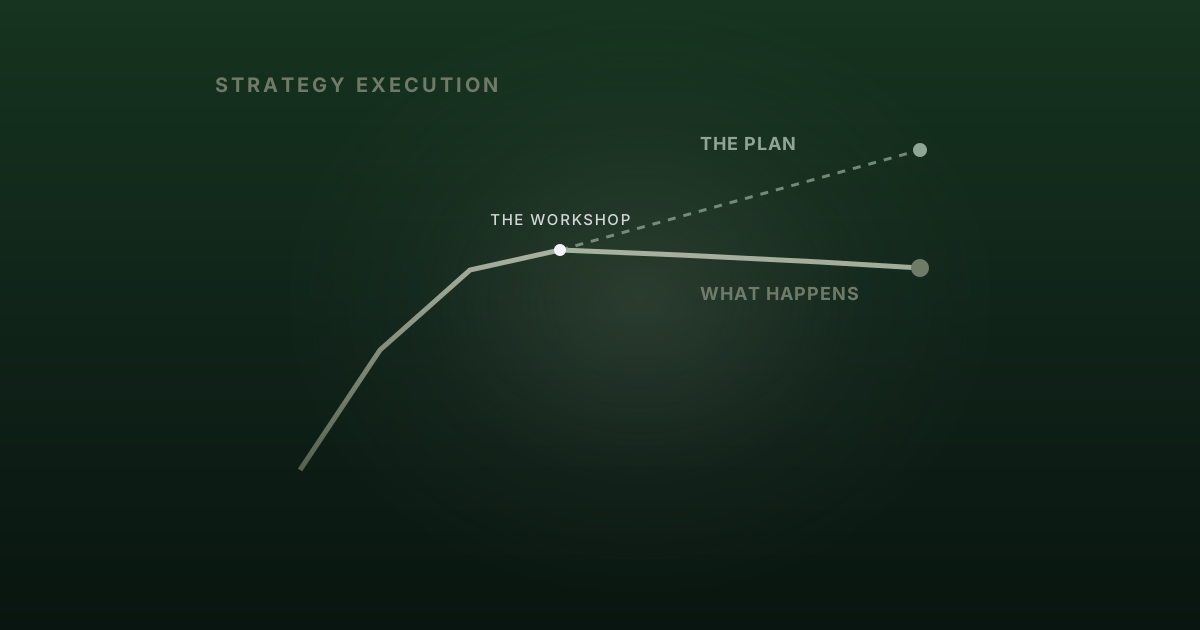
Strategic planning is rarely the problem.
Most owner-led businesses can bring the right people into a room, review performance, discuss opportunities and agree on a direction. The conversation is often productive. Important issues are surfaced. Priorities become clearer. There is usually genuine alignment by the end of the day.
The plan may be well considered. The leadership team may leave with energy and confidence. The next steps may even be documented.
Then the business resumes.
Customers need attention. Employees require decisions. Sales opportunities emerge. Operational problems interrupt the week. Managers return to the pressures already sitting in front of them.
Within a month, the strategic plan has become one more item competing for attention. Within a quarter, parts of it are already out of date. By the next planning cycle, the business is discussing many of the same issues again.
This is not usually because the strategy was poor or because the leadership team lacked commitment. It happens because the business treated strategy as an event rather than as a management system.
The workshop created direction. It did not create the management system required to convert that direction into results.
The workshop is the easiest part
Planning workshops are valuable because they create space away from the daily operation.
Leadership can step back, examine the business more objectively and consider questions that are difficult to address during a normal week. Where should the business focus? Which markets are attractive? What needs to improve? What should be stopped? What capabilities need to be built? What should the organisation look like in three years?
These are important questions. The workshop provides a structured environment in which to discuss them.
The problem is that a strategic decision made in a workshop does not automatically become part of the way the business operates.
It must still compete for capital, management attention, people, systems and time. It must survive contact with existing priorities. It must be translated into work that individuals understand and can execute. It must be measured. It must be reviewed. It must be adjusted when assumptions change.
The strategic workshop usually resolves only the first question: What do we want to do?
Execution requires the business to answer several more. What exactly will change? Who is accountable? What resources are required? What work will stop? How will progress be measured? What decisions need to be made, and by when? How will leadership respond when execution falls behind?
Most plans weaken in the gap between those questions.
Strategy is often expressed too broadly
Many strategic plans contain sensible themes. Grow revenue. Improve customer experience. Build leadership capability. Diversify the customer base. Strengthen systems. Increase operational efficiency.
These may all be valid ambitions, but they are not yet executable priorities. They do not define the specific result required, the choices involved or the actions that will change.
Consider the objective: Grow revenue.
That could mean entering a new market, increasing prices, improving conversion, expanding the sales team, introducing a new product, increasing customer retention or acquiring a competitor. Each path requires different capabilities, investment, measures and management attention.
Until the business defines which mechanism will produce the growth, the objective remains an aspiration.
A more useful strategic priority might be: Increase recurring revenue from existing customers from 25 per cent to 40 per cent of total revenue within 18 months by introducing two additional service offerings and improving account management.
That statement creates a clearer basis for execution. It identifies the intended commercial outcome, the target customer group, the mechanism and the timeframe.
The more broadly a strategy is expressed, the easier it is for people to agree with it and the harder it is for anyone to act on it.
Too many priorities usually means no real priorities
Strategic planning often produces a long list of worthwhile initiatives.
The leadership team sees multiple areas requiring attention. There may be opportunities in sales, technology, people, customer experience, systems, products, pricing and operations. The temptation is to include all of them.
This creates a plan that is comprehensive but not prioritised.
A business may describe 10 or 15 initiatives as strategic, while also expecting management to continue delivering normal operations. Each initiative has merit, but the organisation lacks the capacity to execute them all well.
The result is predictable. Work begins across several fronts. Meetings are established. Early activity creates the appearance of progress. Over time, attention becomes fragmented. Dependencies emerge. Managers revert to the most urgent issues. Initiatives lose momentum without being formally stopped.
A strategic plan should force choices. It should clarify not only what the business will do, but what it will defer, reduce or stop.
For most established owner-led businesses, three to five enterprise priorities are enough for a 12-month period. Even that may be ambitious if the priorities are material.
A genuine priority should receive:
- executive attention;
- defined resources;
- clear accountability;
- regular review;
- protection from competing work.
When everything is important, nothing receives that level of commitment.
The plan is not connected to the commercial baseline
A strong strategy should begin with a clear understanding of the current business.
That sounds obvious, but many planning processes move too quickly from discussion into ambition. The leadership team knows the business well, but its knowledge may be based on a mixture of financial reports, operational experience, customer feedback and individual judgement. Important assumptions may not have been tested.
The business may agree to grow a product line without understanding its true contribution margin. It may invest in a customer segment with poor retention. It may target a new channel without understanding acquisition cost or delivery capacity. It may pursue national expansion while the current operating model remains inconsistent. It may commit to hiring before clarifying whether the problem is capacity, productivity or process.
A strategic plan built on an incomplete commercial baseline can create more activity without improving performance.
Before setting the plan, leadership should be able to answer questions such as:
- Which products and services generate the strongest contribution?
- Which customers or segments are most valuable?
- Where is margin being lost?
- What is driving growth?
- Which channels produce profitable customers?
- Where is delivery capacity constrained?
- Which activities depend too heavily on the owner?
- What are the most important external risks and opportunities?
- Which parts of the business are improving, and which are deteriorating?
The purpose is not to delay action until every number is perfect. It is to ensure the strategy is responding to the actual economics and operating reality of the business.
Ownership is assigned to groups rather than individuals
Strategic plans commonly assign responsibility to a function, department or leadership team. Sales will own growth. Operations will improve efficiency. The executive team will develop leadership capability. Marketing will strengthen the brand.
This may indicate involvement, but it does not establish accountability.
Execution becomes more reliable when each strategic outcome has one clearly accountable owner. That person does not need to perform all the work. They may rely on several teams and functions. They do, however, need to be responsible for coordinating delivery, understanding performance, identifying risks and bringing forward decisions.
Shared responsibility often creates a practical gap. Everyone contributes, but no one is clearly answerable for the whole result.
A useful test is simple: If this priority is off track in three months, who will be expected to explain why and present the recovery plan?
If the answer is unclear, accountability has not been properly established.
The accountable owner must also have sufficient authority. It is unreasonable to hold a manager responsible for an outcome while requiring the owner or chief executive to approve every meaningful decision. Accountability and decision rights need to be designed together.
Strategic priorities are not translated into operating work
A strategic plan often sits at a level that makes sense to the board or leadership team but remains abstract to the people responsible for execution.
For example: Improve customer experience.
That direction may require changes to sales, onboarding, service delivery, systems, communication, training and complaint management. Unless the priority is broken into specific work, each function may interpret it differently.
Sales may focus on faster response times. Operations may focus on process consistency. Marketing may revise customer communications. Technology may introduce a new system.
All of these actions may be useful, but they may not address the main cause of the customer problem.
Translation is the bridge between strategy and execution. For each priority, the business should define:
- the outcome required;
- the current baseline;
- the principal causes being addressed;
- the few actions expected to produce the result;
- the accountable owner;
- the people required to contribute;
- the resources needed;
- the milestones;
- the measures of progress and success;
- the decisions leadership must make.
This does not require a large project plan. It requires enough clarity for people to understand what will actually change.
The plan is added on top of existing work
One of the most common reasons strategic plans fail is that no capacity is created to deliver them.
The leadership team agrees on several new priorities and then returns those priorities to people whose time is already committed. No roles are adjusted. No projects are stopped. No meetings are removed. No budget is reallocated. No operational expectations are reduced.
The strategy becomes additional work rather than the organising logic of the business.
This is particularly common in owner-led businesses because the organisation is accustomed to responding through effort. When something matters, capable people work harder. That may be effective for short periods. It is not a reliable model for sustained strategic execution.
Every material priority has a cost. It will consume management attention, employee capacity, capital or all three. The business needs to decide where that capacity will come from.
A useful question during planning is: What will we stop doing, delay or do differently to make room for this priority?
If leadership cannot answer that question, the priority may not be adequately resourced.
Measures focus on activity rather than outcomes
When strategic initiatives begin, progress is often reported through activity. Meetings have been held. The new system has been selected. A project team has been formed. The campaign has launched. Training has been completed.
These are signs that work is occurring. They do not necessarily show that the strategy is producing a result.
An effective strategic measure should help leadership distinguish between implementation progress and commercial impact.
For example, a business seeking to improve customer retention may track implementation measures:
- account-management process designed;
- customer reviews completed;
- renewal workflow implemented;
- team training completed.
And performance measures:
- customer retention rate;
- churn rate;
- revenue retained;
- expansion revenue;
- customer profitability.
Both types of measures matter. Implementation measures show whether the planned work is happening. Performance measures show whether that work is changing the business.
Without this distinction, an initiative can appear successful because the actions were completed even though the commercial outcome did not improve.
Strategic progress is reviewed too infrequently
Many businesses review their strategy quarterly, half-yearly or when the next planning session approaches. That is too late for active execution.
Strategic priorities do not need to dominate every weekly meeting, but they do require a consistent review cadence. Without regular review, small delays become significant. Dependencies remain unresolved. Resource problems persist. Assumptions change without the plan being updated. Weak progress becomes normalised.
A practical cadence may include a weekly operational review, focused on immediate performance, exceptions and decisions, where strategic actions may appear if they affect current execution. A monthly strategic performance review, which examines each priority against milestones and outcome measures and identifies variance, causes, risks and required decisions. And a quarterly strategy review, which assesses whether the priorities and assumptions remain valid, reallocates resources, adjusts the plan and stops work that is no longer justified.
These forums serve different purposes. The monthly review is particularly important. It prevents the strategic plan from becoming separate from normal management.
A useful review should answer:
- What result were we expecting?
- What has actually occurred?
- What explains the difference?
- Is the original assumption still valid?
- What decision or intervention is now required?
- Who will act, and by when?
The discussion should focus on causes and decisions rather than status updates.
Leadership tolerates missed commitments for too long
Execution discipline is shaped by what leadership accepts.
A milestone is missed. The reason appears understandable. The date is moved. At the next review, progress remains limited. Competing priorities are cited. The initiative continues.
Over time, the organisation learns that strategic commitments are flexible while operational demands are immediate.
This does not mean leadership should respond harshly to every delay. Plans need to adapt. New information emerges. Dependencies change. Some assumptions prove wrong.
The important distinction is between conscious adjustment and passive drift.
When a commitment is missed, leadership should determine:
- whether the priority remains important;
- whether the accountable owner has sufficient capacity and authority;
- whether the plan was realistic;
- whether the required work has been displaced;
- whether a decision has been avoided;
- whether the initiative should be reset or stopped.
Simply extending the date does not address the cause. Good strategic governance creates a culture in which commitments are taken seriously, while allowing rational changes where the evidence supports them.
The owner continues to make every important decision
In many owner-led businesses, the strategic plan creates new responsibilities for managers while decision-making remains concentrated with the owner.
Managers are asked to lead initiatives, but pricing, hiring, expenditure, supplier selection and major customer decisions continue to require approval. This creates a hidden execution bottleneck.
The owner may be trying to maintain control and protect the business. The practical result can be slower progress, reduced accountability and managers waiting for direction.
For each strategic priority, leadership should identify the decisions that will need to be made and assign appropriate authority in advance. This may involve clear thresholds for:
- expenditure;
- hiring;
- discounts;
- supplier commitments;
- process changes;
- customer remediation;
- project scope;
- resource allocation.
The aim is not to remove owner oversight. It is to ensure that oversight is applied where it adds value rather than becoming the default mechanism for every decision.
The plan remains static while the business changes
A strategic plan should provide direction, not create inflexibility.
Markets change. Competitors act. Customer behaviour shifts. Employees leave. Opportunities emerge. Costs move. Technology develops. A plan that cannot adapt will eventually become irrelevant.
The opposite problem is equally damaging. If priorities change every time a new opportunity appears, the business never builds execution momentum.
The discipline lies in distinguishing between useful adaptation and strategic distraction. A priority should be reconsidered when:
- a core assumption has changed;
- the expected economics are no longer attractive;
- a material risk has emerged;
- the required capability is unavailable;
- better evidence points to a different course;
- another opportunity has a clearly superior strategic value.
It should not be abandoned simply because execution has become difficult or a more interesting idea has appeared.
This is why regular strategic review matters. It gives leadership a formal mechanism for making deliberate adjustments rather than allowing the plan to drift informally.
Turning the plan into a management system
A strategic plan becomes useful when it changes how the business allocates attention, resources and accountability. That requires more than a document. It requires a small number of priorities, clear commercial outcomes, named owners, adequate resources, visible measures and a regular decision-making cadence.
A practical strategic execution framework should include the following.
1. Define the commercial outcome
Each priority should explain what will improve and by how much.
Instead of: Develop the commercial market. Use: Increase commercial-sector revenue from $2 million to $3.5 million over 18 months while maintaining gross margin above 30 per cent.
Instead of: Improve efficiency. Use: Reduce average delivery cost by 12 per cent within 12 months without reducing customer satisfaction or quality.
Specific outcomes create better discussion and make it easier to determine whether the strategy is working.
2. Confirm the mechanism
Leadership should be explicit about how the result is expected to occur. If the goal is revenue growth, is it expected to come from:
- new customers;
- higher prices;
- increased customer spend;
- new products;
- new locations;
- improved conversion;
- better retention;
- acquisition?
A clear mechanism allows the business to test whether the strategy is producing the expected effect.
3. Assign one accountable owner
Every strategic priority should have one person responsible for the overall outcome. That person should understand the target, dependencies, risks and decisions required. They should also have sufficient authority or a clear escalation pathway.
4. Break the priority into 90-day commitments
Annual goals are too distant to manage directly. Each priority should be translated into a small number of 90-day outcomes or milestones. This creates a practical execution horizon while preserving the longer-term direction. At the end of each quarter, the business can assess whether the priority is progressing, needs adjustment or should be stopped.
5. Allocate capacity deliberately
Leadership should identify the people, time and capital required. It should also decide what work will be reduced, delayed or discontinued. This is where strategy becomes real. A priority that receives no resource reallocation is usually an intention rather than a commitment.
6. Use a concise strategic scorecard
The scorecard should include:
- the strategic outcome;
- current performance;
- target performance;
- key milestones;
- accountable owner;
- status;
- major risks;
- decisions required.
It should be brief enough to support discussion rather than becoming a reporting exercise.
7. Establish a monthly review
The monthly strategic review should be part of the management system, not an optional meeting. It should focus on variance, causes, decisions and accountability. The purpose is not to celebrate activity. It is to determine whether the business is moving toward the intended result and what leadership needs to do next.
A practical first 30 days after the workshop
The period immediately after the planning workshop is critical. Momentum is highest, but so is the risk that daily operations will reclaim attention.
Within the first week, leadership should:
- confirm the final priorities;
- define the commercial outcomes;
- appoint accountable owners;
- identify major dependencies;
- agree on the measures;
- confirm the first 90-day commitments.
Within the first two weeks, accountable owners should:
- develop the execution plan;
- identify the resources required;
- surface decisions that need leadership approval;
- confirm what existing work will be affected;
- establish baseline performance.
Within the first month, the business should:
- commence the monthly strategic review;
- publish the strategic scorecard;
- resolve early resource conflicts;
- stop or defer competing initiatives;
- communicate the priorities to the wider organisation in practical terms.
The first month sets the standard. If deadlines are missed, accountability is unclear and competing work remains untouched, the organisation will quickly understand that the plan is secondary to normal operations.
Strategy succeeds when it changes management behaviour
A strategic plan is not successful because it is thoughtful, comprehensive or well presented. It succeeds when it changes what the business does.
It changes where capital is invested. It changes which opportunities are pursued. It changes what managers are accountable for. It changes which work receives attention. It changes which activities stop. It changes the information leadership reviews and the decisions it makes.
For owner-led businesses, the challenge is rarely a lack of ideas or ambition. It is creating enough discipline around the chosen direction to prevent the organisation from being pulled back into its existing patterns.
The planning workshop matters. It creates the opportunity to step back, make choices and set direction. But the real work begins when the workshop ends. That is when the strategy must move from the room into the monthly review of the business.
Without that transition, the plan remains a statement of intent. With it, strategy becomes a practical system for producing a different result.
Every business has one constraint doing most of the damage.
Find out what's constraining yours →2 questions · 60 seconds · No login