
Why RTO Enrolments Stall, and What Actually Moves Them
Trent West ·
Time to read: 8 minutes.
When an RTO stops growing, the reflex is almost always to sell harder. More marketing spend to fill the top of the funnel. More agents or education consultants working the leads. Lower fees or a discount to get the numbers up. A few new courses added to scope to open another market. Each of these feels like doing something about the problem, and each of them can work when the problem is genuinely a demand problem. Most of the time it isn’t, and pushing harder on the sales side just spends money faster against a limit that sits somewhere else entirely.
That’s the expensive part. When enrolments have plateaued because the commercial model underneath has hit a limit, adding acquisition spend doesn’t lift the number. It thins the margin on every student you already have and adds students the business can’t profitably service. The provider ends up busier, poorer, and more convinced it has tried everything, when what it has actually tried is the one lever that was never going to move.
The number that grows isn’t always the number that matters
Enrolments are the figure everyone watches, because it’s the visible one and it feels like the measure of health. But an RTO doesn’t get paid for an enrolment. It gets paid for a student who starts, progresses, and completes, on economics that leave something behind after the cost of winning and delivering the course. Two providers can add the same 500 enrolments and have completely different businesses at the end of it, depending on what those enrolments cost to acquire and whether the students actually finish.
This is where a lot of RTO growth quietly destroys value. The enrolment line goes up, the owner feels the business is growing, and margin is going backwards the whole time because each new enrolment costs more to win and deliver than it returns. Fixing the economics of a single enrolment, so that adding students adds margin, does more for the business than any campaign aimed at adding more of them.
Where RTO growth actually gets stuck
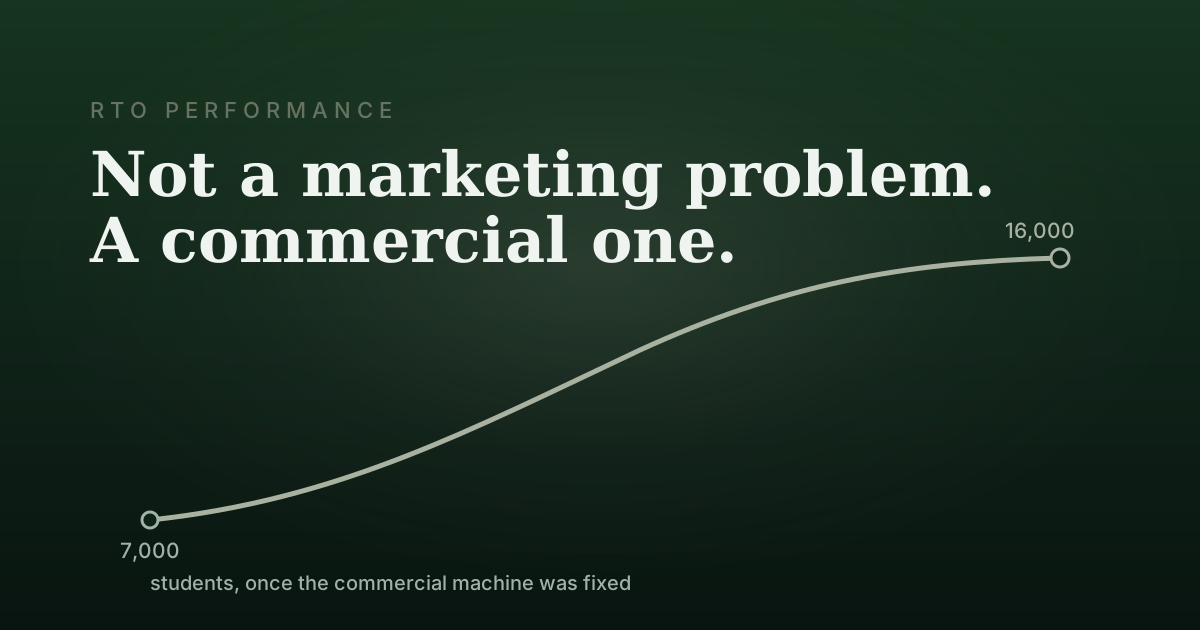
Having taken a national vocational provider from roughly 7,000 to 16,000 students, the constraint that stops growth is rarely the one owners reach for first. A few come up repeatedly.
Acquisition cost that nobody measures by channel. Plenty of RTOs can buy enrolments through agents, brokers, paid search, and social. Very few can tell you what a student actually costs to acquire on each of those channels, once you count the full cost of winning them, delivering the training, and supporting them to completion. Without channel-level cost per acquisition, the business is flying blind: it keeps feeding the channels that are easiest to spend on rather than the ones that make money, and often the highest-volume channel is the one quietly running at a loss. You can’t fix acquisition economics you’ve never actually measured, and the blended average across all channels hides exactly the thing you need to see.
A generic message against a student’s real outcome. Most RTO marketing sells the course. The student is buying the outcome, and in vocational education that outcome is usually a better job. A message built around qualifications, quality training, and flexible study competes with every other provider saying the same words, so it converts on price and pushes acquisition cost up. A message built around the employment result the student actually wants, backed by real completion and outcome data, converts better, attracts students more likely to finish, and lets the provider stop competing purely on fee. The value proposition is a commercial lever, not a branding exercise.
Delivery capacity that can’t take the volume. Trainers and assessors are the real delivery capacity of an RTO, and they don’t scale the way a forecast assumes. Push enrolments past what the trainer base can service properly and completions slip, students disengage, and the business spends on remediation and re-enrolment instead of growth. The ceiling sits in the capacity to deliver what the pipeline brings in, well before it sits in the pipeline.
Completion and funding realisation. In a subsidised or funded model, the revenue often depends on students hitting milestones or completing, not just enrolling. A provider can enrol strongly and still starve if students don’t progress, because the money that was assumed at enrolment never fully lands. The gap between enrolled revenue and realised revenue is where a lot of RTOs bleed without seeing it clearly.
Reputation as a commercial input. In vocational education, student sentiment drives referrals, completions, and the willingness of the next cohort to enrol. A provider with a falling rating is fighting its own reputation for every new student, and no amount of agent activity or ad spend outruns that. Getting delivery right so the rating recovers is a growth lever in its own right.
Every process should earn its place
Underneath all of this is how the work actually gets done. In most RTOs, operational processes accumulate over years, layer on layer, and nobody stops to ask why half of them still exist. Some genuinely move a student toward completion. Some are there to meet a real regulatory obligation. A surprising number do neither, and just sit in the way, adding cost and creating friction on the student’s path without anyone being able to say what they’re for.
Being intentional means knowing, for every significant process, three things: what it’s meant to achieve, how it should actually run, and above all why it’s done at all. The why is the one that gets skipped, and it’s the one that matters most. A process whose only justification is that it’s always been done that way is usually either friction slowing a student toward their outcome or cost with no return behind it. The few processes that genuinely serve the student’s outcome or keep the provider on the right side of its obligations are worth protecting fiercely. Everything else is a candidate for removal, and clearing it out is often where both margin and student experience improve at the same time.
The loop that actually drives an RTO
Here’s the big one, and it’s the thing most providers never quite close. The most durable growth engine in vocational education is a loop that connects three parties: the student, industry, and the provider.
The student enrols to get somewhere, and in vocational education that somewhere is almost always a better job. Industry needs skilled people it can actually hire. When the training genuinely connects those two, so that what’s taught maps to what employers need and students come out employable in roles that really exist, the loop closes. Students complete, because the course visibly leads somewhere. Employers hire the graduates and come back for more. That industry demand feeds referrals, reputation, and the next cohort, and enrolments stop depending so heavily on paid acquisition because the outcome starts selling the course on its own.
Break any link and the loop leaks. Train for outcomes industry doesn’t actually value, and completions and employment both fall, which surfaces later as a reputation problem and a funding problem. Enrol students industry can’t or won’t place, and the same thing happens one step further down. The providers that grow durably are the ones that treat the student-to-industry connection as the core of the business rather than as something that happens on its own after graduation. It’s the hardest thing for a competitor to copy, and it’s what a buyer ultimately pays the most for, because a closed loop is what makes the enrolments durable rather than bought.
What moved the number, concretely
The provider that went from 7,000 to 16,000 students didn’t get there on a marketing push. At the low point it was losing around $40,000 a week, its rating had fallen to roughly 1.5 stars, and it looked busy while haemorrhaging cash. The growth came from fixing the commercial machine underneath.
Acquisition hygiene was corrected so that adding students created margin rather than losses. Financial management was rebuilt so the business could actually see where money was made and lost, which is harder than it sounds in a provider with mixed funding and long completion timelines. A scalable workforce model returned teaching hours and quality to students, which pulled the rating back toward 4.5 stars and won two national awards for customer service, and that recovering reputation did real commercial work on the next intake. The business moved from weekly cash losses to around $10M EBITDA inside 12 to 18 months, and became the largest provider in the country. None of that was a growth tactic. It was commercial and operating repair that let growth actually happen.
The honest qualifier
Sometimes the answer really is more marketing. A genuinely under-marketed RTO with sound economics and spare delivery capacity should absolutely spend to grow, and treating a real demand problem as if it were a structural one would leave money on the table. The point isn’t that sales and marketing don’t matter. The point is that when the business is losing money or stuck at the same enrolment level year after year, the constraint is usually in the economics and the delivery rather than the top of the funnel, and spending harder on acquisition against that kind of constraint makes the position worse rather than better. The first job is to know which problem you actually have.
Where the value really sits
For an owner thinking about eventually selling or stepping back, this matters twice over. An RTO that grows because its commercial model works is worth far more than one propped up by acquisition spend, because a buyer prices the durability of the enrolments, not just the headline number. Enrolment economics that hold up, a delivery model that scales, and a reputation that feeds the next intake are exactly what earns a higher multiple. The same work that breaks a growth plateau builds the enterprise value you’ll want when it’s time to exit.
If your RTO has stopped growing and the usual levers aren’t moving it, the useful first step is a clear read on where the business is actually constrained commercially, from someone who has run the numbers inside a scaling provider rather than from outside the sector. That’s what a Commercial Assessment is built to surface, and the work takes it through to fixing the constraint that’s holding enrolments and margin down.
Every business has one constraint doing most of the damage.
Find out what's constraining yours →2 questions · 60 seconds · No login