
Why Your Business Growth Has Stalled
Trent West ·
Time to read: 7 minutes.
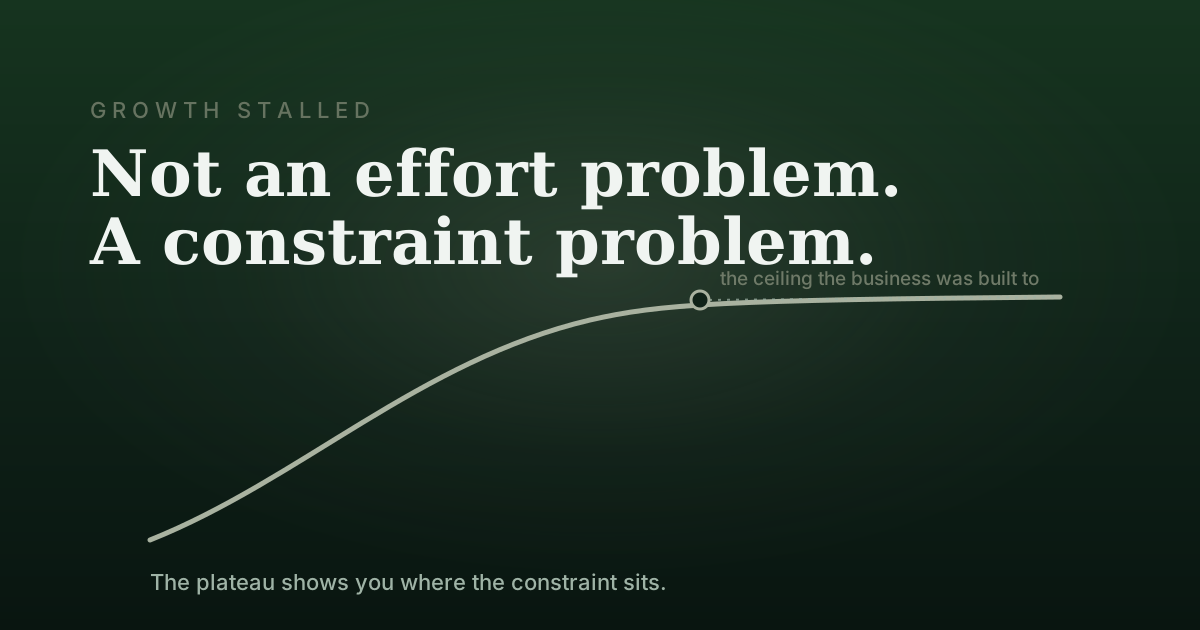
The instinct when growth stalls is to push harder. More sales activity, more marketing spend, a new product line, another hire on the commercial team. It feels like the right response, and it’s usually the wrong one, because a business working flat out at the same revenue for two years running doesn’t have an effort problem. It has a constraint, and effort applied anywhere except the constraint just burns cash and tires people out.
That’s the frustrating thing about a plateau. The harder the team works without moving the number, the more certain everyone becomes that the answer is to work harder still. Meanwhile the actual cause sits somewhere in how the business is put together, invisible in the monthly accounts, doing its quiet work of capping the whole thing at a level nobody chose.
A plateau is a signal, not a slump
Revenue doesn’t go sideways for no reason. When a business grows and then stops at a particular level and holds there, that level is telling you something specific: the business has hit the ceiling of how it’s currently built. Something in the model, the cost structure, the pricing, or the way work flows through the place can support this much and no more.
The number itself is a clue. A business that plateaus at $6M didn’t run out of market. Most markets are far bigger than any one owner-led business inside them. It ran out of some internal capacity to convert opportunity into profitable revenue, and it did so at $6M rather than $4M or $9M for a reason worth understanding. The plateau is the business showing you where its binding constraint sits, if you read it as information rather than as a slump to be pushed through.
Where the constraint usually hides
A plateau is rarely one clean cause. More often it’s two or three structural issues that each look manageable on their own and compound into a ceiling when they stack up. A few patterns come up again and again.
Growth stopped being profitable before it stopped being possible. The business could sell more, but the next dollar of revenue costs more to win and deliver than the last one did, so the owner instinctively pulls back without ever deciding to. The plateau is the business self-limiting at the point where growth stopped paying.
The commercial model outgrew itself. A way of selling and delivering that worked cleanly at $3M carries hidden friction at $8M. More coordination, more exceptions, more things that only work because someone is holding them together by hand. Throughput falls even as headcount rises, and the business runs harder to stay in the same place.
The bottleneck is a person, often the owner. Every significant deal, decision, or exception routes through one desk, and that desk is full. The business can’t grow faster than that one person can process what comes back to them, and no amount of sales activity changes it, because the constraint is downstream of the sale.
Capacity is real and nobody’s costed it. Sometimes the ceiling is physical: a plant at its limit, a delivery team fully booked, a system that can’t take more volume without breaking. This one’s almost welcome, because it’s the most fixable once it’s named. The trap is spending on sales to fill a pipeline the business can’t actually service.
Why pushing harder makes it worse
Here’s the part that catches good operators. When the constraint is structural, adding effort or resource doesn’t just fail to help. It actively degrades the business, because you’re adding cost against a ceiling that hasn’t moved.
Hire two salespeople to break a plateau caused by a delivery bottleneck, and you’ve added fixed cost to win work the business can’t deliver, so service slips, existing customers get worse outcomes, and margin compresses under the weight of people who can’t be productive. The plateau holds, the cost base is now higher, and the business is genuinely worse off than before it tried. This is how a plateau turns into a decline: not because the business stopped trying, but because it kept spending against the wrong constraint until the spending itself became the problem.
The honest exception
Not every flat year is a structural plateau, and it’s worth being straight about that before tearing the business apart looking for a constraint that isn’t there. Sometimes revenue is flat because the market genuinely contracted, a major customer left, or the business is deliberately holding steady while it fixes something else. A single sideways year inside a volatile market isn’t necessarily a signal at all. The tell for a real structural plateau is persistence: two or three years at the same level, through decent conditions, with the team at full stretch and the returns still not improving. That pattern is the one that points inward, and that’s the one worth the diagnostic.
The part owners don’t see: it caps your value too
A plateau doesn’t just hold your income flat. It sets a ceiling on what the business is worth, because a buyer prices growth. Enterprise value is the market’s confidence that future cash flows will arrive, and a business that has visibly stopped growing gives a buyer very little reason to believe next year beats this one. Same earnings, a lower multiple, because the growth story a buyer would pay up for isn’t there.
Worse, the buyer often reads the plateau more harshly than you do. Where you see a business holding steady, they see a business that has found its ceiling and may be one bad year from sliding off it. So the plateau costs you twice: once in the growth you’re not getting now, and again in the multiple you won’t get when you sell. The Enterprise Value Gap Calculator puts a rough number on that second cost. Finding and breaking the actual constraint is a value-creation exercise, not just a growth one.
Finding the real one
The reason plateaus persist is that the visible symptom and the actual constraint are usually in different places, and the accounts as normally kept won’t tell them apart. It takes reading the business at a level most monthly reporting doesn’t reach: unit economics rather than aggregate P&L, margin by product and customer rather than in total, where throughput actually slows, and where cost has been added that the revenue never justified. That’s slower and more forensic than a sales review, and it’s the only thing that reliably separates the symptom you can see from the constraint that’s actually doing the damage.
If your revenue has held flat for a couple of years while the effort hasn’t, the useful first step is a clear read on where the business is actually constrained, done from outside the day-to-day where the pattern is easier to see. That’s what a Commercial Assessment is built to find, and the underperformance work takes it from diagnosis through to breaking the constraint that’s holding the number down.
Every business has one constraint doing most of the damage.
Find out what's constraining yours →2 questions · 60 seconds · No login