
Do Your Customers Actually Want What You Sell? Measuring Product-Customer Fit
Trent West ·
Time to read: 9 minutes.
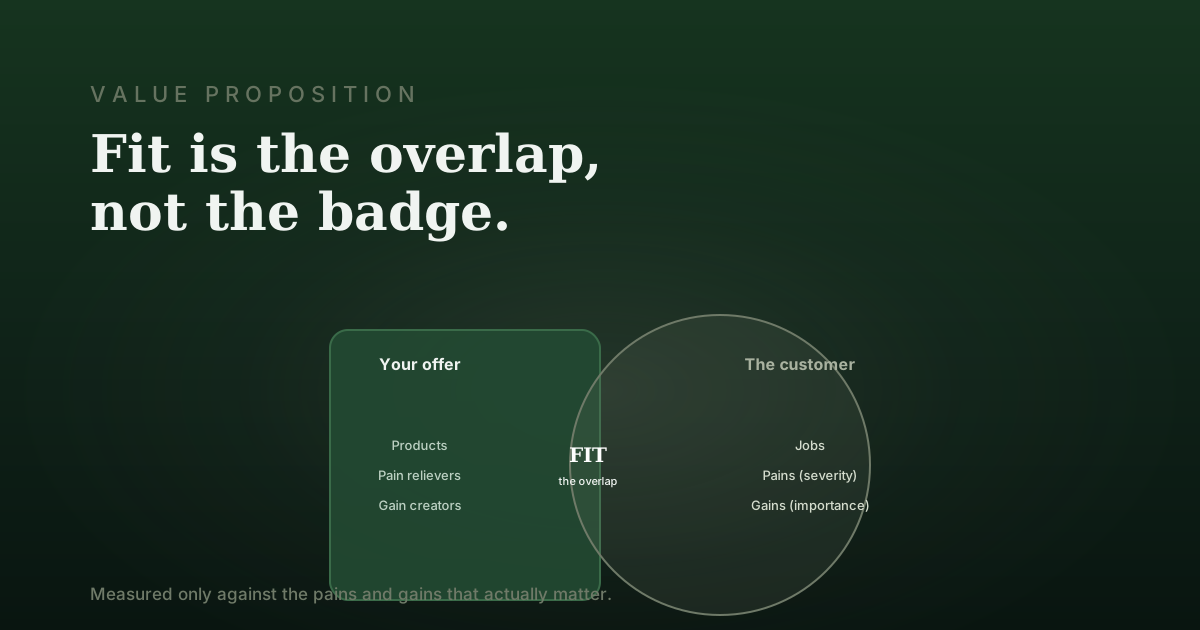
Ask an owner whether they have product-market fit and the answer is almost always yes. It’s the kind of claim that feels obviously true from the inside, because you built the thing, you sell it, and people buy it. But “people buy it” and “we’re the right answer to what customers actually need” are different statements, and the gap between them is exactly where growth quietly stalls. Fit gets treated as a badge you award yourself. It’s more useful as something you can measure, and the tool for measuring it is older and simpler than most owners expect.
Two sides that have to line up
The value proposition canvas is built on a deceptively simple idea: there are two sides, and fit is how well they overlap. On one side is the customer, described not by demographics but by three things: the jobs they’re trying to get done, the pains they hit trying to do them, and the gains they’d value. On the other side is your offer, described as the products and services you provide, the ways those relieve specific pains, and the ways they create specific gains. Fit is not “we have a good product.” Fit is a pain reliever pointing at a real pain, and a gain creator pointing at a real gain. When you draw both sides honestly, the overlap is usually smaller than anyone expected, and the shape of the mismatch is the whole finding.
Not all pains count, and that’s the point
Here’s where most fit conversations go wrong. Owners list every pain their product touches and every gain it offers, tally them up, and conclude the fit is strong. But a value proposition that relieves ten trivial pains and misses the one that keeps the customer awake at night has poor fit, not good fit, however long the list looks. So the discipline is to weight before you count. Rate each pain by severity and each gain by importance, and then measure fit only against the ones that actually matter: the severe pains and the important gains. Relieving a minor irritation is not fit. Relieving the thing the customer would switch suppliers to escape is.
That turns fit from a vibe into a number. Take the severe pains, the ones a customer would rate at the top of the scale, and ask how many of them your offer genuinely relieves. That’s your pain-relief coverage. Do the same for the important gains: how many does your offer actually create? That’s your gain-creation coverage. The two together give you a fit score you can defend, and more usefully, a list of the specific high-severity pains you’re leaving completely unaddressed. That list is worth more than the score, because it’s the roadmap.
Jobs, and the trap of the functional one
Underneath pains and gains sit the jobs the customer is trying to do, and it’s worth being honest that jobs come in more than one flavour. There’s the functional job, which is the obvious one: the accounting firm files the return, the manufacturer ships the order. But there’s usually an emotional job sitting beside it, like wanting to feel in control rather than anxious at month-end, and sometimes a social one, like wanting to look credible to a board or a bank. Businesses that only compete on the functional job leave the emotional and social ones unmet, and those are often where loyalty and premium pricing actually live.
The most useful way to read jobs is to score two things: how important the job is to the customer, and how satisfied they currently are with how it gets done. The jobs that are high in importance and low in satisfaction are your openings. A customer who badly needs something done and is frustrated with every current option is not a marketing problem, they’re an unserved market, and finding those underserved jobs is often more valuable than improving what you already do well.
Why customers actually move
The last piece is the one owners find most uncomfortable, because it’s about loss as much as gain. Customers switch, in both directions, and the reasons they switch to you are not always the mirror image of why they leave. A switch toward you might be about a capability gap in their current supplier; a switch away might be about a single bad delivery, or a relationship that went cold, or a competitor who simply asked for the business at the right moment. Treating these switching triggers as directional signals, and being specific about which direction each one runs, tells you where your fit is winning customers and where it’s quietly losing them, which a static satisfaction survey never will.
The honest limit of fit
The concession worth making is that fit is necessary and not sufficient. You can have genuinely excellent fit, a value proposition that relieves the severe pains and creates the important gains for a clearly defined segment, and still not build much enterprise value, because the segment is too small, shrinking, or structurally low-margin. Fit tells you that customers want what you sell. It doesn’t tell you that enough of them exist, or that serving them is profitable. That’s why a serious assessment reads fit alongside the size, growth and margin of the segment it applies to, rather than treating a strong canvas as the finish line. A perfect answer to a question too few people are asking is still a problem.
But that caveat cuts the other way too. When you find strong fit in a segment that is large, growing and profitable, you’ve found where to point everything, and when you find a severe pain nobody in the market is relieving, you’ve found whitespace worth building toward. Either way, the value of the exercise is that it converts a vague sense of “our customers like us” into specific, weighted, addressable gaps.
You can run this on one of your own segments with the Value Proposition Fit Builder: list the pains and gains that matter, mark which ones you actually address, and get a coverage-based fit score with the unmet ones named. It’s the same canvas a Commercial Assessment builds properly against real customer evidence, and where it finds an unrelieved pain that matters, the APG Platform turns it into a valued, owned initiative rather than a note in a workshop.
Every business has one constraint doing most of the damage.
Find out what's constraining yours →2 questions · 60 seconds · No login