
Why Strategy Only Creates Value When the Loop Closes
Trent West ·
Time to read: 8 minutes.
Most owner-led businesses don’t have a strategy problem. They have a drawer full of strategy: the offsite deck, the consultant’s report, the plan from the last planning day, all of it reasonable, most of it never delivered. The thinking was usually fine. What failed was everything that had to happen between the recommendation and the result, and that gap is where the value quietly leaks away.
It’s worth being precise about where it leaks, because “we struggle with execution” is too vague to fix. There are five specific gaps between a recommendation and money in the bank, and a plan that falls into any one of them stops creating value. Most plans fall into all five.
Gap one: no number
The recommendation says “improve pricing discipline” or “reduce customer concentration,” and everyone nods, because it’s obviously sensible. But nobody has said what it’s worth. Is it a $50K idea or a $500K one? Without a number, it can’t be ranked against anything else, so it competes for attention on how good it sounds rather than what it would add. The loudest initiative wins, not the most valuable one.
A recommendation without a value attached is just an opinion with a to-do list. Putting a defensible number on one is its own discipline, worked through in what an initiative is actually worth.
Gap two: no order
Even with numbers, a list of fifteen good initiatives is not a plan, because a business can’t do fifteen things at once. Capacity is the binding constraint on execution, and a list that ignores it guarantees that everything gets a little attention and nothing gets finished. Some initiatives depend on others. Some free up the capacity the rest need. Without a deliberate sequence, the business spreads itself across the whole list and delivers a fraction of any of it.
Gap three: no owner
This is the one that kills the most plans quietly. An initiative that belongs to “the team,” or to a committee, or to everyone, belongs to no one. It has no single person whose job it is to make it happen, whose week it shows up in, who is asked about it by name. So it loses, every time, to the work that does have an owner: the day job. The urgent, owned, in-your-inbox work beats the important, unowned, in-the-plan work on every ordinary Tuesday, and the plan dies not in a decision but in a hundred small deferrals. That daily loss has a name and a fix of its own, covered in why the plan loses to the day job.
Gap four: no mechanism
Even a valued, sequenced, owned initiative needs a place to live and a rhythm to move it. Not a governance ritual, a working mechanism: the initiative broken into the actual work, milestones that mean something, a cadence where progress is looked at and the next move decided. Without it, “own the pricing work” is an instruction with nowhere to happen, and the owner is left to fit strategic change into the margins of an already-full week. The mechanism is what turns an intention into motion.
Gap five: no reconciliation
The last gap is the subtlest and the most expensive. When an initiative was supposed to add $200K, does anyone ever check whether it did? Almost never. The plan gets made, the year happens, and the estimate is never held against the accounts. So nobody learns which initiatives actually paid, the forecasts never get better, and the business can’t tell the difference between work that’s creating value and work that’s just creating activity. If it doesn’t show up in the accounts, and nobody checks the accounts, it may as well not have happened.
The loop that closes all five
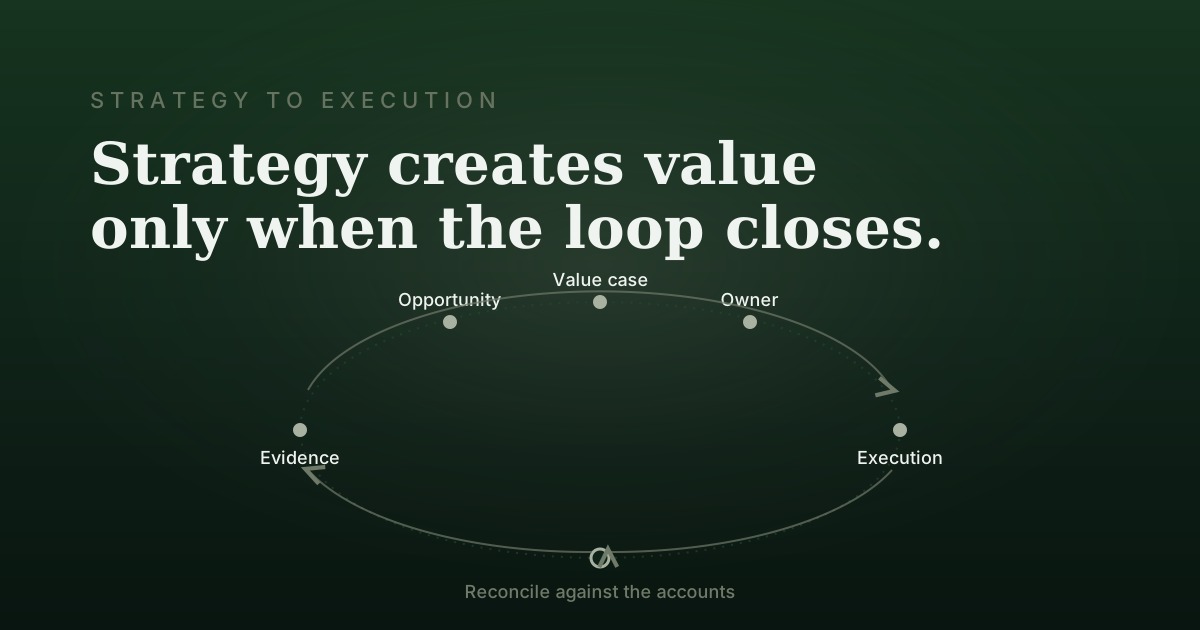
Notice that these aren’t five separate problems, they’re five points on a single loop that most plans leave open. The loop runs from the owner’s actual goal, to the evidence of where value is being made and lost, to the opportunities that evidence reveals, to a genuine choice about which to pursue, to a value case that puts a defensible number on the chosen few, to execution with a real owner and rhythm, to reconciliation against the accounts, and back to updated evidence.
Closed, that loop has a property no static plan has: it improves itself. Each month the estimates meet reality, the ones that were wrong get corrected, and the next round of choices is made on better information. The plan stops being a document that decays from the day it’s written and becomes a model of the business that gets sharper the longer it runs.
That is the difference between a strategy and a system for creating value. One is a set of good intentions. The other is a mechanism where every recommendation is evidenced, every initiative is valued, every commitment is owned, and every result is reconciled.
Where to start
You don’t need to close all five gaps at once, and you can’t. But you can find out how open they are. If you can’t put a number on your top three initiatives, or name the single owner of each, or say what last year’s plan actually delivered against what it promised, the gaps are open and the value is leaking.
The Initiative Value Tracker is a way to see it: value your initiatives, net the cost of getting there, and watch how much of the total is still only a promise rather than a delivered result. That gap between committed and delivered is the execution gap, made visible.
Closing it is what a Commercial Assessment begins and the APG Platform sustains: the evidence, the value cases, the owners, and the monthly reconciliation that keeps the loop closed. The plan you can rely on is the one you can watch land in the accounts, not the one that looks best on the day.
Every business has one constraint doing most of the damage.
Find out what's constraining yours →2 questions · 60 seconds · No login