
The Right People in the Right Seats: Two Tests, Not One
Trent West ·
Time to read: 9 minutes.
When a business isn’t performing, the people lever is the one owners reach for first, because it feels the most within their control. Hire someone stronger, have the hard conversation, move the boxes on the org chart around. Sometimes that’s right. Much of the time it changes very little, and the reason is uncomfortable: the results a business is getting are usually the results it’s currently built to produce, not the results its people are capable of. Before you conclude you have the wrong people, it’s worth being precise about what “right” even means, because it’s two separate questions wearing one label.
Two questions that get collapsed into one
“Are they any good?” is not a question, it’s two. The first is whether they’re the right person: do they share how the business is meant to operate, its actual values, the way it treats customers and each other. The second is whether they’re in the right seat: can they do this specific job, well, and want to. A business that doesn’t separate these ends up making bad calls in both directions. It keeps a brilliant performer who quietly corrodes the culture, calling them “a great operator with a bit of an edge.” And it carries a much-loved, loyal person who can’t actually do the role, calling them “a safe pair of hands.” Both mistakes come from answering with a single gut verdict instead of two specific ones.
The right person: values you can actually score
The right-person test is about values, and the trap is treating values as a poster in the break room rather than something you assess. The discipline is to name your handful of real values, the ones that describe how the business genuinely works rather than how the website says it does, and then to score each person against each one. A simple three-point scale does the job: a plus if they clearly live it, a minus if they clearly don’t, and a plus-minus for the honest middle. Someone is the right person when they hold at least a plus-minus on every value, because values are a floor, not an average. A single hard minus on a value that matters is not offset by being wonderful on the others, which is exactly the judgement a blended score hides.
The right seat: fit, drive and capability
The right-seat test is about the role, and it has three parts that need to be true together. Fit is role clarity: does this seat match who they are and what they bring, or are they being asked to be someone they’re not. Drive is motivation: are they genuinely energised by this particular work, not just willing to do it. Capability is delivery: can they perform the role to the standard it actually requires. The reason all three have to hold is that any one of them failing produces the same visible symptom, underperformance, with completely different causes and completely different fixes. Someone with the capability and the fit but no drive is bored, and more training won’t touch it. Someone with the drive and the fit but not the capability is trying hard and drowning. A seat only fits when fit, drive and capability are all a clear plus.
Four positions, four different moves
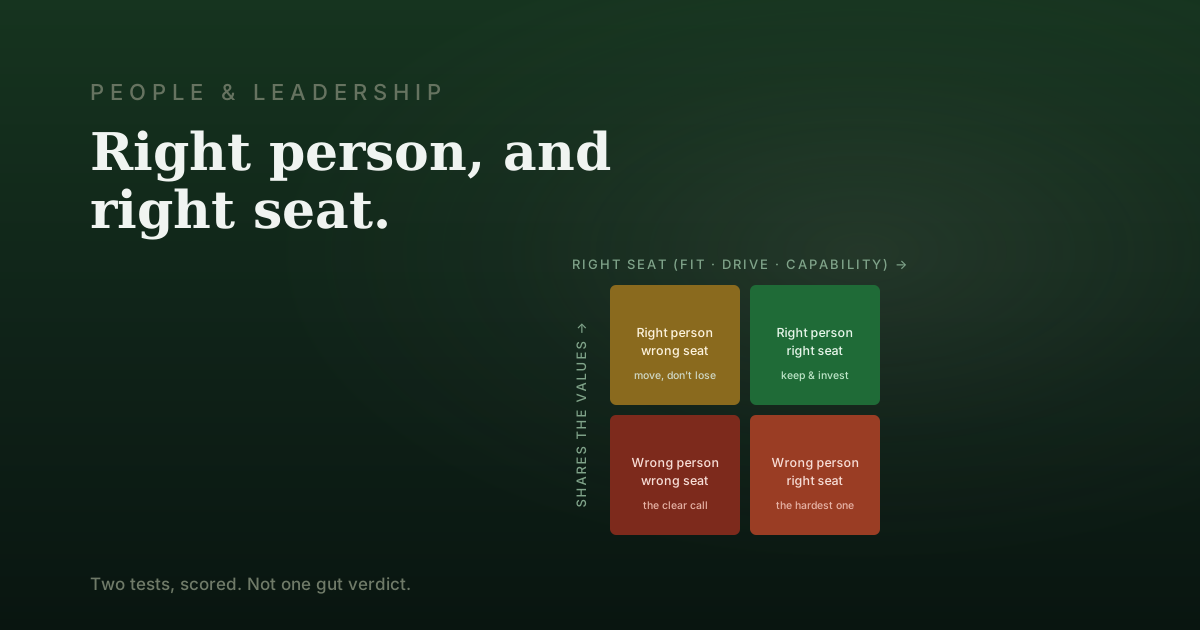
Cross the two tests and you get four positions, and the value is that each calls for a genuinely different response. Right person, right seat is straightforward: keep them, invest in them, and protect them from the churn around them. Wrong person, wrong seat is also straightforward, in the other direction. The two that owners handle badly are the mixed ones. Right person but wrong seat is the one most often misread as a firing decision when it’s usually a design decision: you have someone who belongs in the business but not in that chair, and the move is to find the seat that fits, not to lose them. Wrong person but right seat is the hardest, because their competence makes the values problem easy to tolerate, and tolerating it is how a culture quietly rots from a strong performer outward.
Seats before names
None of this means much until the seats themselves are defined, which is why the accountability chart matters more than the org chart. An org chart shows who reports to whom. An accountability chart defines each seat by what it is accountable for, before you put a name in it. Doing it in that order surfaces things that reporting lines hide: seats that don’t really exist but that someone is heroically covering, accountabilities that two people both think they own so neither does, and the seat that only one person can fill, which is key-person risk wearing a job title. Asking whether someone is in the right seat is meaningless until you’ve said what the seat is accountable for.
The honest limits
Two concessions are worth making plainly. The first is that a people assessment, unlike a commercial one, doesn’t resolve into a clean number that flows to enterprise value. Its connection to value is real but narrative: a thin leadership bench, a business that only runs because one person holds it together, an owner with no succession, these are precisely what a buyer probes for and discounts against, so the work shows up in the multiple rather than in a line of the model. The second concession is the more important one. Because the people lever feels so available, it gets pulled when the real constraint is the system, and you can do real damage replacing capable people who were only ever failing because the business was built to make them fail. A people assessment is only safe when it’s read alongside the system those people work inside, so you can tell a genuine people problem from a structural one wearing a person’s face.
Much of the time, though, the picture that emerges is clarifying rather than damning: a couple of people plainly in the right place, one or two in the wrong seat who belong somewhere better, and a values call that everyone had been avoiding. You can work through your own leadership team with the Right Person / Right Seat tool: score each person on your values and on fit, drive and capability, and see where each one lands. It pairs with the Owner Dependency Score for the key-person side of the question, and it’s the same read a Commercial Assessment builds properly and the APG Platform holds alongside everything else the business is built to produce.
Every business has one constraint doing most of the damage.
Find out what's constraining yours →2 questions · 60 seconds · No login