
The Seven-Part Business Health Check (and Why Your Weakest Part Isn't Where You Think)
Trent West ·
Time to read: 9 minutes.
Ask an owner how their business is doing and you’ll get a surprisingly confident answer, delivered mostly from the parts they understand best. Founders who came up through operations will tell you the operation is tight and gloss over the commercial engine; founders who came up through sales will do the reverse. This isn’t dishonesty, it’s the ordinary human tendency to assess yourself generously where you’re comfortable and to look away from where you’re not. A structured diagnostic exists to interrupt that, by scoring the whole business on one scale, including the parts you’d rather not examine, and then doing something most self-assessments skip: weighting the parts, because a business doesn’t fail evenly.
Seven domains, scored on the same scale
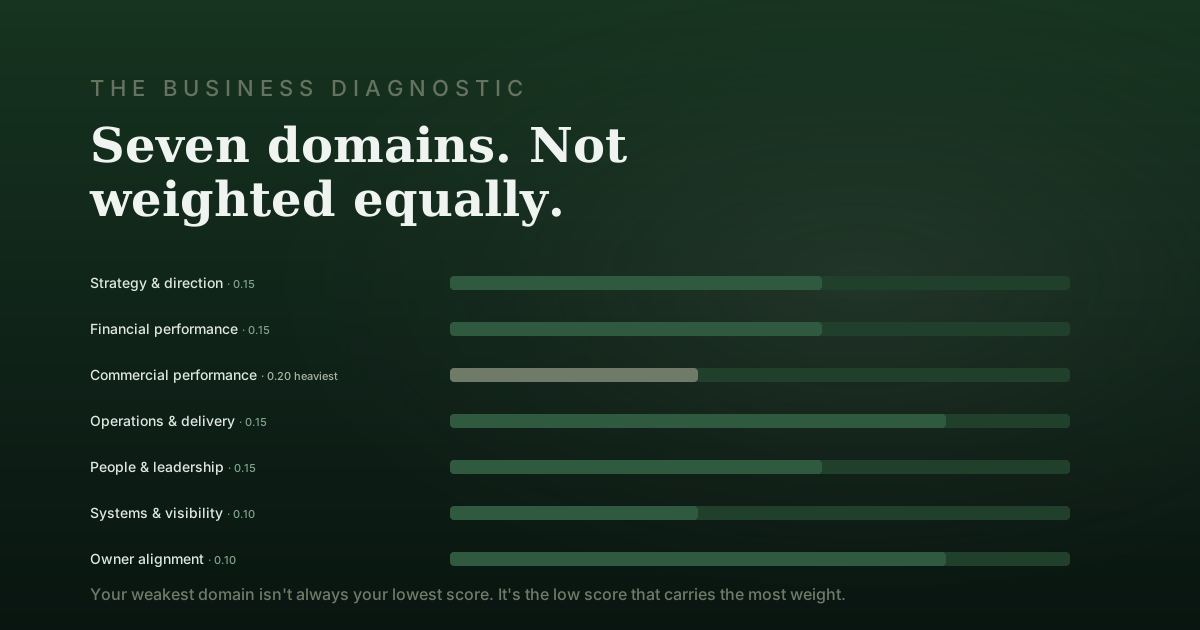
A useful business diagnostic reads across seven domains, chosen to cover the whole of a business without overlapping. Strategy and direction: how clearly you’ve defined where you’re going and whether intent translates into action. Financial performance: cash generation, margins, controls, and readiness to invest. Commercial performance: how reliably you acquire profitable revenue, the quality of that revenue, and your exposure to concentration. Operations and delivery: your capacity to deliver consistently and to scale. People and leadership: the strength of the team and of the leadership above it. Systems and visibility: whether your technology and data actually give you reliable sight of what’s happening. And owner alignment: whether the owner’s own goals and the business’s trajectory still fit. Scoring each one, honestly, from weak to strong, is uncomfortable in a specific way, because it forces the same rating scale onto the domain you’re proud of and the domain you’ve been avoiding.
The weighting is where the insight hides
Scoring the domains is useful. Weighting them is where the diagnostic earns its keep, because the domains do not matter equally to whether the business thrives. Commercial performance carries the most weight, and deliberately so: a business can be strong at almost everything else and still fail if it can’t reliably win profitable customers, because that’s the engine everything else runs on. Weighting changes the answer to “where should I focus.” A weighted view doesn’t point you at your lowest raw score, it points you at the place where lifting your score buys the most health, and that is usually a domain that is both weak and heavily weighted. For a lot of owners, that turns out to be the commercial engine they’d quietly assumed was fine, rather than the operations they’ve spent years perfecting.
There’s also a domain here that most business frameworks leave out entirely, and it’s the one that matters most for an owner-led business: owner alignment. It asks whether what the owner now wants and where the business is actually heading still point the same way. A business can be objectively healthy on the other six domains and still be quietly failing its owner, because it’s become the wrong business for the life they now want, or because the owner’s decisions and the business’s needs have drifted apart. Left unnamed, that misalignment leaks into every other domain as hesitation, mixed signals and half-made decisions.
The blind spot is the whole reason to measure
The real value of a diagnostic isn’t the score, it’s the gap between how you score yourself and how the business would score under an honest, evidence-based look. That gap has a name worth using: the blind spot. And blind spots aren’t randomly distributed, they cluster exactly where your identity is most invested. The founder who built the business on relationships will rate the commercial domain highly, on instinct, and is the least able to see that the acquisition engine has quietly stopped working. The technical founder will defend the product and miss that the systems giving them visibility are held together with spreadsheets. The tell is a high score you’re giving on gut rather than evidence, and the discipline is to separate the two, to ask of every strong self-rating: could I actually prove this, or do I just feel it. The domains you rate highly but can’t evidence are exactly where an independent read tends to find the surprises.
The honest limits
Two caveats keep a self-diagnostic useful rather than reassuring. The first is that a mirror flatters, and a self-assessment is a mirror; the score you give yourself is a prompt for a harder look, not a verdict, and its greatest value is often in the questions it makes you unable to avoid rather than the number it produces. The second is that seven domains is a simplification of a system that doesn’t come in tidy boxes. The domains interact, a weakness in one shows up as a symptom in another, and a low score in systems and visibility can be the reason your commercial and financial scores are guesses in the first place. Read as a starting map rather than a finished diagnosis, though, it does something valuable: it makes you look at the whole business, on one scale, and it stops you mistaking the part you understand best for the part that matters most.
You can score your own business with the Business Health Check: rate the seven domains, mark which scores you can actually evidence, and see your weighted health, your biggest weighted opportunity, and where your likely blind spots are. When it points at a weak domain, the Value Chain Hotspot tool helps you find where inside it to act, and a Commercial Assessment provides the independent, evidence-based read that a self-score can’t, which is the only reliable way to see past your own blind spots. The APG Platform then keeps the picture current as the business changes.
Every business has one constraint doing most of the damage.
Find out what's constraining yours →2 questions · 60 seconds · No login