
What an Initiative Is Actually Worth: the Value Case
Trent West ·
Time to read: 7 minutes.
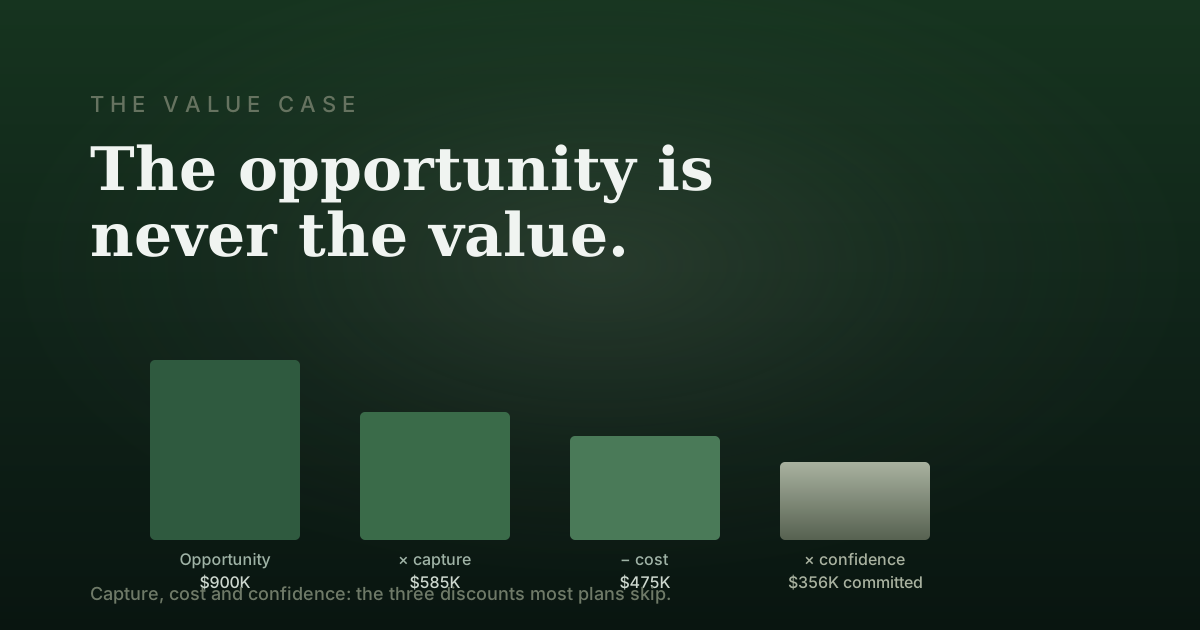
Every improvement plan is full of big numbers. “There’s a million dollars in pricing.” “Fixing utilisation is worth half a million.” The numbers feel like value, and they get treated like it, which is exactly how plans end up promising far more than they deliver. The number at the top of an opportunity is almost never what the business will actually bank. What it banks is what’s left after three honest discounts, and the discipline of applying them is what turns an opportunity into a value case.
The opportunity is the ceiling, not the answer
Start with the gross opportunity: the full prize if everything went perfectly. Say a pricing review identifies $900K of margin sitting in under-priced work. That’s real, and it’s worth naming. But it’s the ceiling. No business captures the whole of a pricing opportunity, because some customers push back, some contracts can’t be touched until renewal, and some of the theoretical gain was never collectable. So the first honest question isn’t “how big is it,” it’s “how much of it will we actually capture.”
If you can realistically hold about 65% of it, the $900K opportunity is a $585K opportunity. Nothing has gone wrong. You’ve just stopped counting money you were never going to see.
Then subtract what it costs to get
The next discount is the cost to achieve. A pricing change might need a few months of a commercial manager’s time, a new quoting tool, maybe some churn as you reset the book. Those costs come off the top, and they come in three flavours that a serious value case keeps separate: the one-off cost to implement it, any capex the change requires, and the ongoing annual cost of sustaining it. The ongoing cost is the one owners forget, because it quietly eats the recurring benefit every year after the applause has stopped.
Net the cost, and the $585K might become $475K. Still a strong initiative. But now it’s a number that accounts for the effort, not just the prize.
Then discount for how sure you actually are
The last discount is the honest one, and the one most plans skip entirely: confidence. How sure are you, really, that this lands the way you think? A pricing initiative you’ve run before in a stable market might be 80% confidence. A new channel you’ve never tried, dependent on a hire you haven’t made, might be 40%. Confidence isn’t pessimism, it’s a way of comparing a sure $300K against a speculative $800K on the same footing, so the plan doesn’t over-weight the exciting long shots.
Apply, say, 75% confidence to the $475K, and you land at roughly $356K. That is the committed value: what this initiative is genuinely worth to the plan, after capture, cost and confidence. It’s less than half the headline $900K, and it’s a number you can actually stand behind.
Why this matters more than it looks
Doing this to one initiative is useful. Doing it to all of them is transformative, because it changes what the plan optimises for. When every initiative is reduced to its committed value on the same basis, they can finally be compared. The exciting idea with a big gross number and low confidence sits down next to the dull, certain one, and often the dull one wins. Capacity, which is always the real constraint, goes to the work that will actually pay rather than the work that sounds best in the room.
It also makes the plan honest about its total. Add up the committed values and you have a defensible figure for what the whole plan should add, one you can bridge from today’s EBITDA to your target and, at your multiple, translate into enterprise value. Add up the gross opportunities instead, as most plans quietly do, and you have a number that was never going to be real, which is why the year always seems to fall short of the plan.
The one thing to hold onto
A committed value is still an estimate made before the work happens, and estimates made early are usually wrong, in both directions. The point of the value case is to make the assumptions explicit, not to predict perfectly, so that when the result comes in you can see exactly where you were right and where you weren’t, and get better at the next one. An initiative with a stated value hypothesis can be reconciled against the accounts. An initiative that was only ever a big round number can’t be, which is why nobody ever learns from it.
You can put your own initiatives through this with the Initiative Value Tracker: enter the gross opportunity, the capture, the costs and your confidence, and it builds the committed value, the bridge to your target, and the enterprise value the plan creates. It’s the same value case a Commercial Assessment builds properly, and the APG Platform then reconciles against your actual numbers every month, so the estimate and the result finally meet.
Every business has one constraint doing most of the damage.
Find out what's constraining yours →2 questions · 60 seconds · No login