
Why the Plan Loses to the Day Job
Trent West ·
Time to read: 7 minutes.
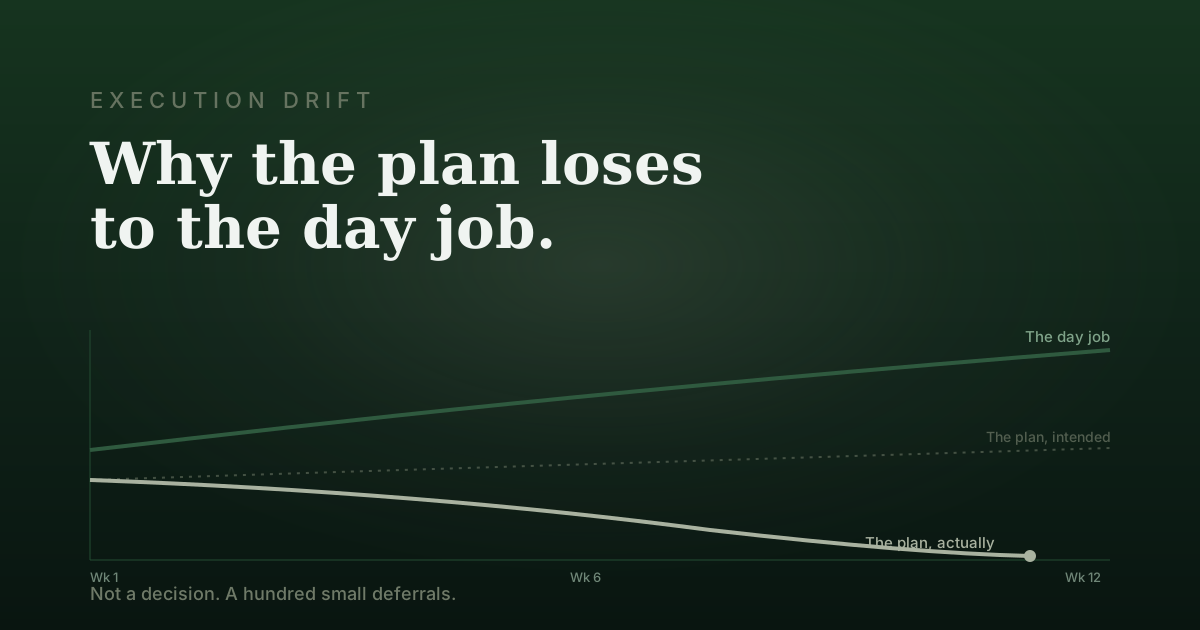
There’s a comforting story owners tell about failed plans: the strategy was wrong, the market moved, the idea didn’t work. Sometimes that’s true. Far more often the plan was fine and simply never happened, dissolved not in a decision but in a hundred ordinary Tuesdays where something more urgent came up. That slow, invisible loss has a name worth using, because naming it is the first step to stopping it. Call it execution drift.
The unfair fight
Every week, the important work of the plan competes for the same hours as the urgent work of the business, and it’s not a fair fight. The urgent work has a customer waiting, an invoice due, a fire visibly burning. It has a name attached and a deadline that hurts if you miss it. The strategic work has none of that. “Improve pricing discipline” has no angry customer, no Friday deadline, no one asking where it is by lunchtime. So when the week fills up, as every week does, the plan is what gets pushed to next week. It always survives the triage, because deferring it costs nothing today. The cost only shows up much later, in a year that fell short of its own plan and nobody can quite say why.
This is why willpower and good intentions don’t fix drift. The people involved aren’t lazy or unconvinced, they’re just responding rationally to the incentives in front of them, and the day job’s incentives are simply louder. Telling everyone to try harder to remember the plan is a strategy that loses to human nature every time.
Drift is a design problem, not a discipline problem
Once you see drift as the predictable result of how the work is set up rather than a failure of character, you can start to fix the setup. The plans that survive contact with a busy week aren’t run by more disciplined people, they’re built so that the important work borrows the same features that make the urgent work win.
The first is a single owner. Work that belongs to “the leadership team” or “operations” belongs to no one, and unowned work is the first thing to fall off a busy week. An initiative with one name against it, one person who is asked about it directly and by name, has someone whose own standing is tied to it moving. That’s the same force that makes the urgent work get done.
The second is a rhythm. The urgent work has a natural cadence: the day, the invoice run, the customer call. Strategic work has none unless you build one. A standing fortnightly point where the owner reports what moved, what didn’t, and what happens next gives the initiative the recurring deadline it otherwise lacks. Not a governance ritual that reviews slides, a working session that moves the actual work.
The third, and the one almost everyone skips, is reconciliation. If nobody ever checks whether the initiative that was supposed to add $200K actually did, then finishing it and quietly abandoning it look identical from the outside. The moment there’s an expectation that the number will be held against the accounts, the work acquires consequence. Reconciliation is what makes the difference between activity and result visible, and visibility is what keeps the loop honest.
The honest objection
It’s fair to push back that some drift is healthy. A rigid plan marched through regardless of what’s changed is its own failure, and a business that never lets the day job interrupt the plan is probably ignoring real signals from its customers. The goal isn’t zero drift. Priorities should shift when the world does. The problem is drift you can’t see and didn’t choose, where the plan erodes by accident rather than by decision. A good system doesn’t stop you changing the plan. It just makes sure that when the plan loses to the day job, it’s because someone decided it should, not because everyone was too busy to notice it slipping.
Seeing your own drift
The hard part of execution drift is that it’s invisible while it’s happening. No single deferral looks like a problem. It only becomes obvious in the aggregate, a year later, and by then the value is gone. So the useful move is to make it visible now, before the year is spent.
The Execution Drift Scorecard is built for exactly that: score your business across the six points where plans leak, and see which one is draining the most value today. Once you can see where the loop is open, closing it stops being a matter of trying harder. It becomes a matter of design: an owner here, a rhythm there, a reconciliation at the end. That is the work a Commercial Assessment sets up and the APG Platform sustains, so the plan you agreed in the room is the plan that shows up in the accounts.
Every business has one constraint doing most of the damage.
Find out what's constraining yours →2 questions · 60 seconds · No login