
How a Logframe Forces You to Think Straight
Trent West ·
Time to read: 9 minutes.
Most business plans share a hidden flaw: they’re a list of things the team will do, with a desirable result written at the top, and nothing in between that honestly explains how the first is supposed to produce the second. The activities are real, the goal is appealing, and the causal chain connecting them is left as an act of faith. There’s an old, unglamorous tool that exists specifically to expose that gap, and the fact that it comes wrapped in the bureaucratic language of international aid projects has stopped more businesses than it should from using it. It’s called the logical framework, or logframe, and used honestly it’s the cheapest thinking discipline you can buy.
A one-page grid that asks four questions of every objective
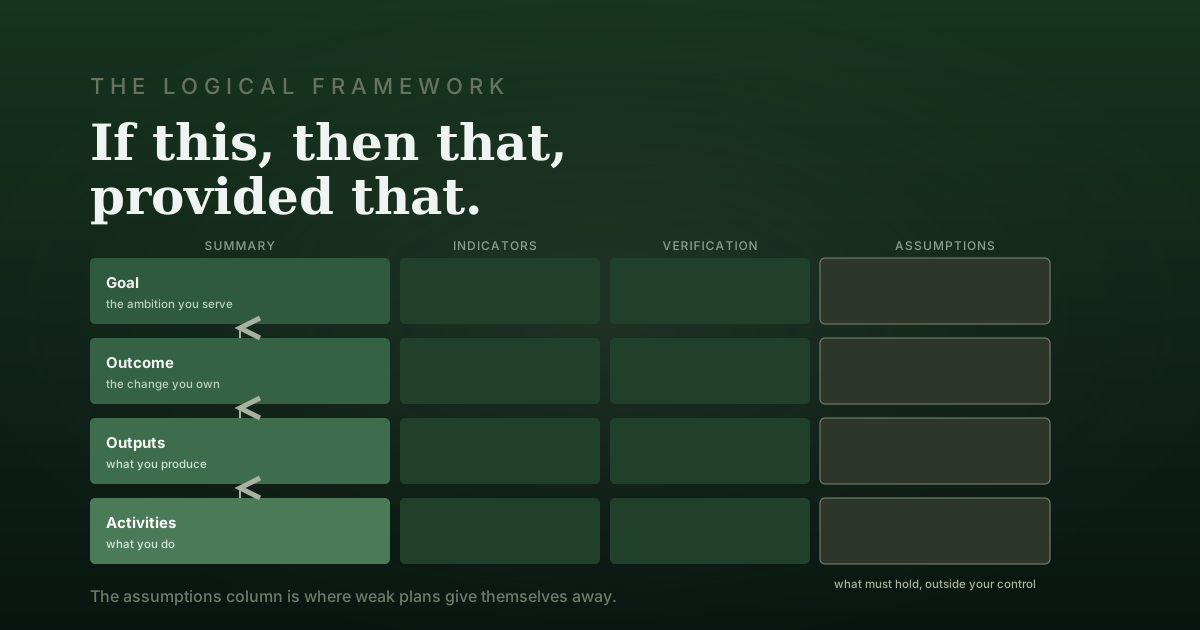
A logframe is a matrix. Down the side runs a hierarchy of objectives, from the most ambitious to the most concrete: the goal you’re contributing to, the outcome you’re directly responsible for, the outputs you’ll produce, and the activities you’ll actually do. Across the top, for every one of those levels, it asks the same four questions. What exactly is it. How will you know it’s been achieved, in measurable terms. Where will you get the evidence to verify that. And, crucially, what has to be true outside your control for this level to lead to the one above it. Filling in the grid is easy. Filling it in honestly is where the thinking happens, because each cell is a question most plans never ask.
The vertical logic that catches the leap of faith
The engine of the logframe is what practitioners call the vertical logic, and it’s read from the bottom up as a chain of conditional statements. If we carry out these activities, then we will produce these outputs, provided our assumptions hold. If we produce these outputs, then we’ll achieve this outcome, provided the next set of assumptions holds. If we achieve the outcome, then we contribute to the goal. Stated that plainly, the weak link in almost every plan becomes visible: there is usually one step in that chain where “if this, then that” is doing an enormous amount of unexamined work. A marketing plan that lists “run the campaign” as an activity and “grow revenue 20%” as the outcome is hiding an entire theory of how attention becomes money in the word “then.” The logframe won’t let you leave it hidden, because the assumptions column is sitting right there, empty, asking what has to be true for the campaign to actually convert.
The assumptions column is the whole point
If you take only one thing from the logframe, take the assumptions column, because no other common planning tool gives equal billing to the things you don’t control. Every plan depends on external conditions holding: that a key hire works out, that a supplier stays solvent, that demand doesn’t soften, that a regulation doesn’t change. Most plans leave these unspoken, which means they get discovered only when one of them fails. Writing them down, level by level, does two useful things. It converts invisible risk into something you can actually watch, because an assumption you’ve named is an assumption you can monitor. And it surfaces the killer assumption: the one that absolutely must hold, that you have low confidence in, and that would sink the whole plan if it broke. Finding a killer assumption before you spend is one of the most valuable outcomes planning can produce, because it tells you to either redesign the plan to remove the dependency, or to stop.
No objective survives without a way to measure it
The two middle columns, indicators and means of verification, do quieter but equally important work: they make vague objectives impossible. An indicator forces every level to state, in advance, what measurable thing would prove it happened, which is fatal to the sort of goal that sounds good and means nothing, like “improve the customer experience” or “become more strategic.” The means of verification then asks the follow-up that kills the remaining hand-waving: where, specifically, will the number come from, and can you actually get it. An objective that can’t name its indicator isn’t ready to be committed to, and an indicator whose evidence you can’t actually obtain is a measurement you’ll never take. Requiring both, up front, is how a plan stops trading in aspirations and starts trading in commitments.
The same discipline, a different lineage
None of this will feel foreign if you’ve thought about strategy as a connected chain rather than a list. The logframe’s objectives hierarchy is a cascade: the goal and outcome are the owner’s ambition and the economic target it implies, the outputs and activities are the results and the initiatives that produce them. Its indicators are your KPIs and key results. Its means of verification is reconciliation, the discipline of checking each claim against a real source rather than a status update. And its assumptions column is the honest accounting for risk and confidence that a proper value case already applies to every number. The logframe is the same closed-loop thinking that turns strategy into realised value, arriving from the development sector rather than the boardroom, and its long, battle-tested history is a decent argument that the logic is sound wherever it comes from.
Where it goes wrong, and how to keep it honest
The logframe has earned some of its bureaucratic reputation, and it’s worth being straight about how. Filled in as a compliance exercise after the real decisions have already been made, it’s worse than useless, a tidy grid that launders a plan nobody pressure-tested. Its neat rows can also imply a false confidence, presenting a messy, uncertain world as though it were a predictable machine. Both failures come from the same mistake: treating the logframe as a document to be completed rather than a conversation to be had. Its entire value is in the doing, early, before positions have hardened, with someone in the room willing to write an uncomfortable assumption in the box and ask whether the plan survives it. And like any plan, a logframe you fill in once and never revisit is just a static document in a nicer format. The point is to hold it up against reality as things move, and change it when the assumptions you named turn out to be wrong.
You can build one now with the Logframe Builder: set out your goal, outcome, outputs and activities, name an indicator and a source for each, and force yourself to write down the assumptions underneath. Then download it as a clean one-pager to work from. It’s the same discipline a Commercial Assessment applies to a real plan, and that the APG Platform then keeps honest by reconciling every commitment against your actual numbers. If you’d rather see the objectives hierarchy in APG’s own terms first, start with how goals, drivers and initiatives connect.
Every business has one constraint doing most of the damage.
Find out what's constraining yours →2 questions · 60 seconds · No login