
Not All Gaps Are Worth Closing: Ranking Capability by What Your Industry Rewards
Trent West ·
Time to read: 8 minutes.
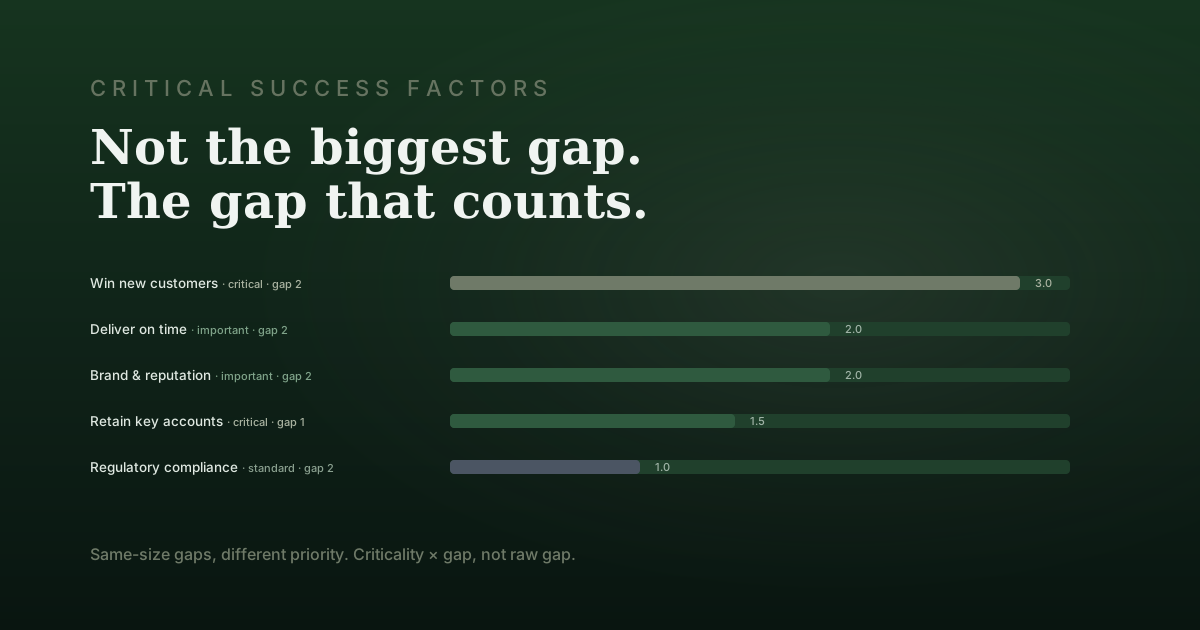
There’s a comfortable version of self-improvement that quietly wastes a lot of effort: you audit the business, find the things you’re worst at, and set about fixing them. It feels responsible, and it’s often the wrong move, because being bad at something and it mattering are different questions, and a capability audit that scores you on everything treats them as the same. It sends you to shore up your biggest weakness, which in plenty of businesses turns out to be something that barely affects whether you win. The sharper question is not where you’re weakest, but where you’re weak on the few things your particular industry actually rewards.
Critical success factors are industry-specific
Every industry has a short list of things a business must get right to win in it, and the list is not the same across industries. In one market, speed and reliability of delivery are what separate winners from also-rans; in another, it’s the depth of client relationships; in another, it’s accreditation, compliance and reputation for safety. These are the critical success factors, and the first discipline is to name yours honestly, for the market you’re actually in rather than the one you’d like to be in. A generic list of business virtues won’t do it, because the whole point is that your industry rewards some capabilities far more than others, and a good list captures that difference rather than smoothing it away.
Rate the gap, then weight it
For each critical success factor, rate two things: how capable you are now, and how capable you need to be to compete. The distance between them is your gap, and only positive gaps matter, because a factor where you’re already at or above the level required is not somewhere to spend. But a gap on its own doesn’t rank the work, and this is where most capability reviews stop and go wrong. A two-point gap on a factor that’s merely nice to have is not the same priority as a two-point gap on a factor that decides who wins, and treating them as equal is exactly the mistake the flat audit makes.
The fix is to weight each gap by how critical the factor is. A factor that’s genuinely critical to winning carries more weight than one that’s standard, so multiplying criticality by the size of the gap turns a flat list of weaknesses into an ordered list of priorities. The arithmetic is simple, and the reordering it produces is the entire value: a small gap on a critical factor can, and often should, outrank a large gap on a standard one.
The reorder is the point
Watch what that does to the list. A generic audit looks at a business and says: your compliance processes are two points below best practice, that’s your biggest gap, go fix it. The criticality-weighted view looks at the same business and says: your compliance gap is real, but compliance is a standard requirement in your market, not a differentiator, so it ranks below the smaller gap you carry on winning new customers, because customer acquisition is critical to whether you survive. Same gaps, completely different marching orders, and the second is right, because it prioritises the work by its effect on winning rather than by the raw size of the shortfall. The thing you’re worst at is frequently not the thing to fix first, and a business that keeps fixing its biggest weaknesses can improve steadily on paper while never getting better at the things that actually decide the game.
Where the capability figure comes from
The ranking is only as good as the two numbers behind each gap, and the current-capability number is the one to be careful with, because it’s a self-rating, and self-ratings flatter. The most reliable version reads capability from a broader, evidence-based diagnostic rather than a gut score, and treats a large divergence between what you feel and what the evidence shows as a reason to distrust that particular gap until you’ve checked it. A confident self-score on a critical factor is precisely where an honest outside read tends to find that the gap is bigger than you thought, which matters more here than anywhere, because that factor is weighted to drive the whole ranking.
The honest caveat
The obvious vulnerability is that the entire exercise rests on getting the critical success factors right, and that’s a judgement, not a fact. Name the wrong factors, or misjudge which are truly critical, and the ranking will point you confidently in the wrong direction, with all the authority of a tidy weighted list. A CSF list built for the industry you wish you were in, rather than the one you’re actually competing in, is worse than no list at all, because it dresses a wrong priority in the language of rigour. So the real work, and the part worth arguing about, is upstream of the arithmetic: it’s the honest conversation about what actually wins in your market. Get that right and the ranking is genuinely useful. Get it wrong and no amount of multiplication saves it.
You can build your own with the Capability Priority Ranker: list your critical success factors, mark how critical each is, rate your current and target capability, and see the gaps re-ranked by what your industry rewards. The current-capability side reads naturally from the Business Health Check, and a Commercial Assessment builds the whole picture from evidence, including the outside read on capability that a self-score can’t give, before the APG Platform turns the top-ranked gaps into owned, valued initiatives.
Every business has one constraint doing most of the damage.
Find out what's constraining yours →2 questions · 60 seconds · No login